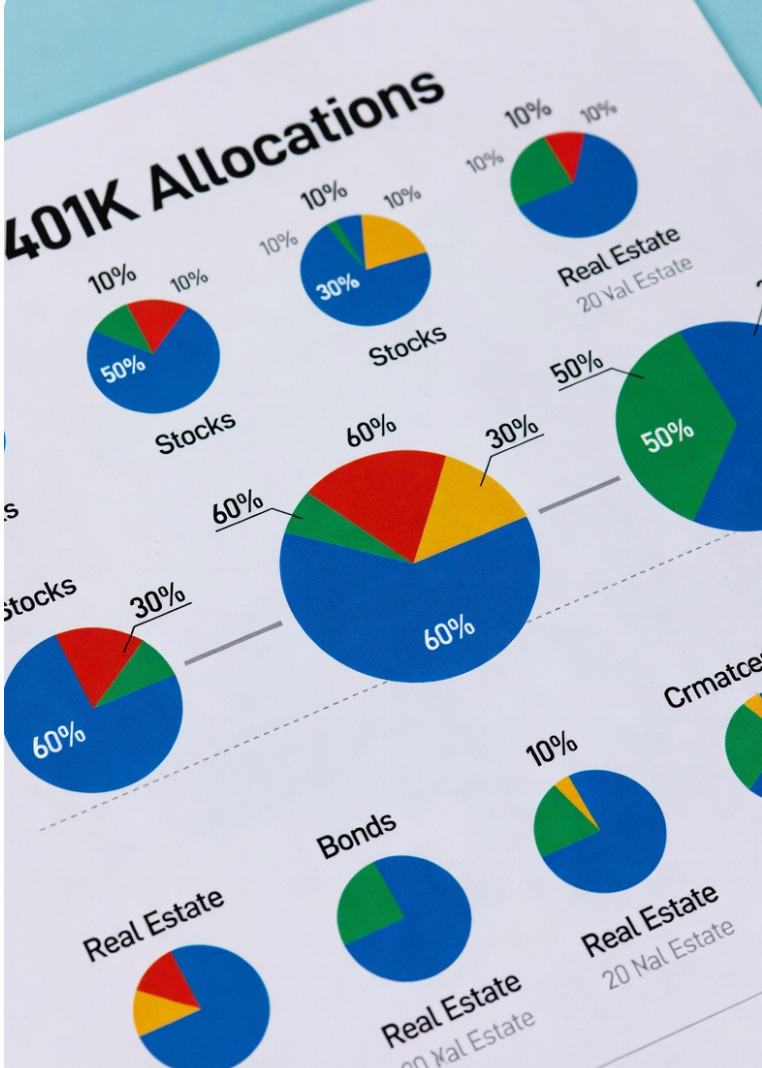
401(k) Asset Allocation: How We Build the Long-Term Pile
401(k) accounts are one of the largest piles most people will ever build… and yet most investors treat them passively, randomly, or emotionally.
The disciplined framework we use to allocate retirement capital across US stocks, global markets, bonds, and real assets
First Rule: Capture the Free Money
Before we talk macro, volatility, or global allocation…
If your employer offers matching → contribute at least enough to capture 100% of the match.
That is an instant 50%–100% return on capital, depending on the structure.
In our framework:
Step 1: Always maximize the match.
Step 2: Then optimize allocation.
Every 401(k) Is Different
Unlike brokerage accounts, 401(k)s have:
Limited fund menus
Pre-selected mutual funds
Target-date funds
Sometimes brokerage windows
Different international exposure options
Different bond choices
That means:
You cannot apply a “one-size-fits-all” strategy.
Instead, you apply asset buckets, then choose the best available option inside each bucket.
The Macro Allocation Framework
For long-term retirement capital, I prefer a core macro allocation model.
This is NOT tactical trading.
This is strategic long-duration positioning.
Example Core Allocation Model (Growth-Oriented Investor)
Why This Structure Works
🇺🇸 US Stocks
Still the most productive equity market globally.
Innovation, capital markets depth, earnings quality.
🌍 International Stocks
Currencies cycle.
Regions cycle.
Leadership rotates.
We’ve seen entire decades where non-US outperforms.
🏦 Bonds
In recessions or deflationary scares:
Bonds stabilize the portfolio.
Even if yields are lower, they reduce volatility.
🪙 Commodities
Inflation hedge.
Currency debasement hedge.
Geopolitical hedge.
If your plan does not offer a commodities fund:
You may substitute with energy, materials, or inflation-protected bonds (TIPS).
Risk-Based Allocation by Age
Instead of arbitrary age rules, I prefer a risk capacity framework:
But remember:
Risk tolerance > Age.
Some 35-year-olds panic in draw-downs.
Some 65-year-olds have strong stomachs and large pensions.
The Biggest Mistakes in 401(k) Allocation
❌ Not capturing the full match
❌ 100% in company stock
❌ 100% in S&P 500
❌ No international exposure
❌ Panic switching during drawdowns
❌ Ignoring inflation
A 401(k) is not a trading account.
It is a compounding engine.
Tactical Overlay (Optional)
If your 401(k) offers a brokerage window:
You may:
Tilt toward small caps in early-cycle expansions
Add duration when recession risk rises
Add commodities during inflation spikes
But if you do not have brokerage flexibility:
Stick to strategic re-balancing annually.
Re-balancing Discipline
Once per year:
Trim what outperformed
Add to what under-performed
Bring allocation back to target
This forces:
Sell high.
Buy lower.
Without emotion.
Final Philosophy
Your 401(k) is:
Not for daily trades.
Not for hero trades.
Not for chasing themes.
It is for:
📈 Compounding
📊 Diversification
⚖ Risk balance
🧠 Discipline
And most importantly:
Consistency beats intensity.
If you want to see how we:
• Structure ETF portfolios
• Build macro allocations
• Overlay options income strategies
• Manage volatility across portfolios
Visit:
👉 www.growyourpile.com
Required Risk Disclosure (As You Requested For Future Posts)
Important Disclosure & Risk Notice
This publication is provided strictly for educational and informational purposes only and is not intended as, and should not be construed as, investment advice, a recommendation, an offer, or a solicitation to buy or sell any security, ETF, digital asset, or investment strategy.
All examples, allocations, model portfolios, and scenarios discussed are illustrative and do not reflect the financial circumstances, objectives, risk tolerance, or needs of any specific individual. Investing involves risk, including the potential loss of principal. Past performance is not indicative of future results. Retirement accounts, including 401(k)s, are subject to specific plan rules, restrictions, fees, and tax considerations that should be reviewed carefully.
Before making any investment decision, investors should conduct their own research and consult with a qualified financial professional.