A Grow Your Pile essay on "Trading Psychology"
The Signal Was Always There — Why Clarity Beats Intelligence in the Markets
There’s a myth almost every trader believes when they start out: that the path to better returns runs through more. More information. More screens. More indicators. More hours staring at the chart, waiting to outwork the market into submission.
We believed it too. Most people never stop believing it. And it’s wrong.
The biggest obstacle for an investor isn’t a lack of intelligence. It’s noise.
Not the market’s noise. Your noise. The static between your ears that drowns out the one thing you actually needed to hear.
Let’s talk about it — because this is the part of trading nobody puts in the brokerage tutorial, and it’s the part that decides whether you keep your pile or give it back.
The Real Enemy Isn’t What You Don’t Know
Ask a struggling trader what they need and they’ll tell you: a better strategy, a faster feed, the next newsletter, one more indicator. They’re certain the answer is out there, one more piece of information away.
It almost never is.
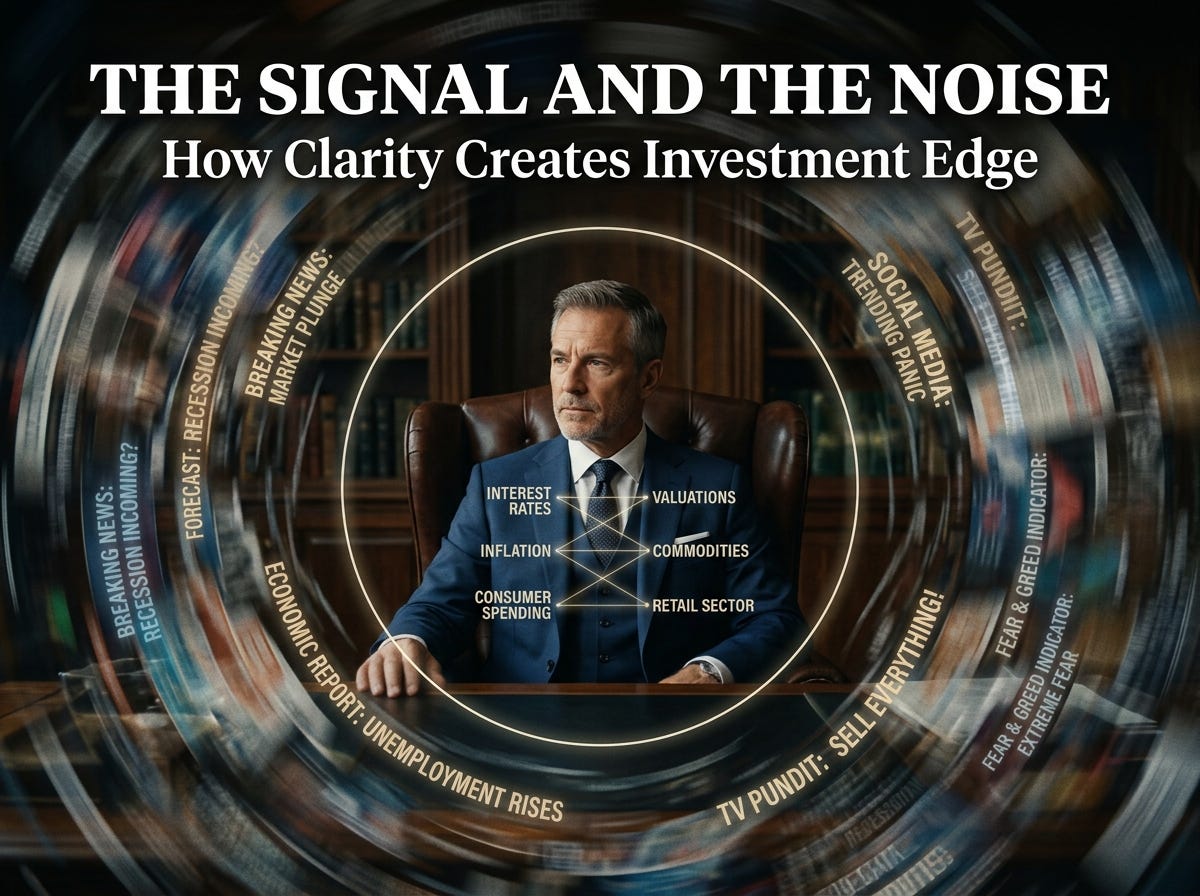
By the time you’re a serious trader, you already have more information than any human in history could process. The 24-hour news cycle, X, CNBC, a dozen Substacks, earnings calls, Fed speeches, options flow — it’s a firehose. And here’s the cruel joke: more information usually makes you worse, not better. Every input is another voice in the room, another reason to second-guess, another emergency that isn’t real.
Same call it interference. We’d call it what every options trader eventually learns to call it: noise that competes with your judgment until your judgment loses.
Think about how your own mind behaves on a hard market day. It replays the trade you should have closed. It invents a crash that hasn’t happened. It refreshes the P&L for the tenth time in an hour. None of that is analysis. All of it is interference — and it’s actively crowding out the clear thinking you need most.
Where Good Ideas Actually Come From
Here’s something experienced traders quietly know and rarely admit: your best ideas almost never arrive while you’re forcing them.
Most successful traders biggest calls didn’t come at the desk grinding through models. They came walking on a beach, swimming, sitting at a bar, reading something completely unrelated — when their mind was quiet enough to let the idea surface.
We’ve lived this. The cleanest reads on a market regime — vol is too cheap here, this rally has no breadth, the bond market is telling a different story than the tape — rarely show up while you’re white-knuckling the screen. They show up in the shower. On a walk. The moment you stop trying to squeeze the answer out.
The conventional belief is:
“If I work harder, I’ll find the answer.”
The trader’s version of wisdom is:
“If I get quieter, I might finally hear it.”
Those are two completely different operating systems. One burns you out. The other compounds.
Intuition Comes First. Analysis Comes Second.
This is the part that makes quants uncomfortable, but every veteran knows it’s true: the feeling usually arrives before the spreadsheet.
You start to notice the tape behaving differently. Sectors that led are quietly lagging. Volatility isn’t acting the way it “should.” Sentiment feels stretched. You can’t prove anything yet — but your subconscious has already flagged that something changed.
The analysis isn’t useless. It’s essential. But its real job is to confirm or kill the instinct — not to generate it. The model is the second step, not the first. The traders who insist on pure data and dismiss the felt sense of a changing market are often the last ones to realize the regime already turned.
Respect the signal. Then go find the evidence.
Stress Doesn’t Just Feel Bad. It Makes You Trade Bad.
Top Hedge fund managers describe waking in the middle of the night convinced something is wrong — not because anything happened, but because stress manufactures imaginary emergencies.
Every trader knows that 3 a.m. feeling. And here’s the cost of it, in dollars:
Stress makes you overtrade — doing something feels safer than sitting still.
It makes you check positions ten times an hour, turning normal noise into false alarms.
It makes you emotional — turning a planned exit into a panic exit.
It makes you see threats everywhere, so you bail on good trades and chase bad ones.
Stress creates noise. Noise destroys judgment. And destroyed judgment is the single most expensive thing in this business — more expensive than any losing trade, because it produces strings of them.
This Is Exactly Why We Trade Mechanically
Here’s where this essay stops being philosophy and becomes the entire reason Grow Your Pile is built the way it is.
When TonyB says “stay mechanical, no hero crap” — that is a noise-reduction system. Read it again with that lens:
Rules and defined risk mean you don’t have to feel your way through a position in real time. The decision was made when you were calm, not when you were scared.
Premium selling is, at its core, a bet on time and probability — it rewards patience and punishes the itch to constantly do something.
Position sizing means no single trade can hijack your emotions, because no single trade can hurt you badly enough to.
Hedges bought when vol is cheap mean you’re never forced to make a terrified decision in a falling market — the protection is already on.
Trading the portfolio, not the trade lifts your eyes off the one flashing number and onto the whole, which is where clarity lives.
A mechanical process isn’t about being robotic. It’s about removing as many opportunities to react emotionally as possible — so that when a real signal does appear, you have the mental quiet to actually act on it. The system exists to protect you from your own static.
The Signal Was Always There
This might be the most important line in this essay, and it deserves to be tattooed on every trading desk:
The signal was already there. The problem was everything else.
The opportunity usually exists before the crowd sees it. The setup is on the chart before the headline explains it. The regime shifts before the pundits agree it has. The edge is rarely hidden — it’s just buried under noise.
Most traders spend their days consuming CNBC, X, forecasts, and hot takes, and then wonder why nothing looks clear. It’s not clear because you’ve buried the signal under a hundred competing voices. Cleaning that static is like tuning a radio: the music was playing the whole time. You just couldn’t hear it over the hiss.
Be Receptive, Not Reactive
There are two kinds of traders.
Reactive traders chase every headline, flinch at every tick, change their opinion with the last loud voice they heard, and trade their emotions. They are busy. They are rarely profitable.
Receptive traders observe, think, wait, and let the pattern come to them. They’re comfortable doing nothing for long stretches. They look almost lazy compared to the reactive crowd — right up until the moment that matters, when they’re the only ones calm enough to act.
The market pays the second group and bills the first. Every time.
Curiosity Beats Certainty
One more theme worth mentioning, be deeply suspicious of certainty — including your own.
The older I get, the more suspicious I become of people who are certain.
Certainty usually means learning has stopped. And markets are a learning machine that never stops changing — the regime, the technology, the politics, the behavior of the other players. The trader who is sure he has it figured out is auditioning to be the next surprise’s victim.
The best traders we know stay relentlessly curious. Their default questions aren’t “How do I prove I’m right?” They’re:
What am I missing?
What actually changed?
Why is the market behaving differently than I expected?
What if my assumptions are wrong?
Curiosity keeps you adaptable. Certainty makes you brittle. In a business defined by change, brittle is fatal.
The GYP Takeaway
Strip it all down and here’s the lesson:
Your edge is not information. Everyone has information. Your edge is not intelligence. The market is full of geniuses who blow up. Your edge is clarity — the ability to reduce noise, control emotion, stay curious, and notice what the noisy crowd missed.
The traders who find the big opportunities usually aren’t the smartest people in the room. They’re the ones who created enough mental space to see.
So before you put on the next trade, run the honest self-check:
Am I seeing the market clearly — or just reacting to noise?
Am I curious — or trying to prove I’m right?
Am I forcing an answer — or creating the conditions where the answer can show up?
And accept the hardest truth in trading: sometimes the most profitable thing you can do is not trade at all. Sometimes it’s taking the walk, turning off CNBC, closing the laptop, and letting the static settle.
Because the signal may already be there.
You just need enough silence to hear it.
Educational content from the Grow Your Pile team. Not investment advice or a recommendation. Options and futures involve substantial risk and are not suitable for all investors.
Want the system we use to keep the noise out — three real-money portfolios, every trade with strikes and sizing, and the full options Masterclass? Join Grow Your Pile →
— Tony Battista & Tony Rihan Grow Your Pile


