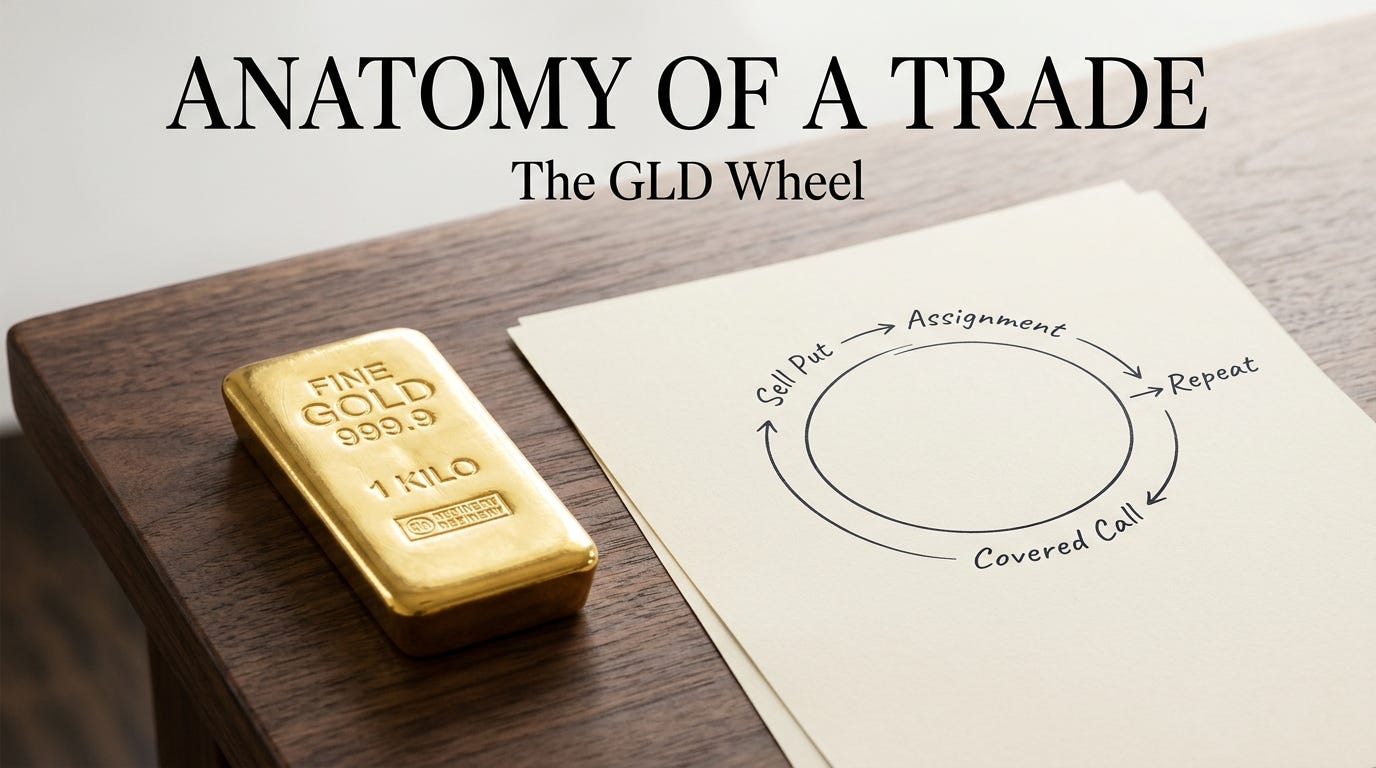
Anatomy of a Trade: The GLD Wheel, Full Cycle
A Grow Your Pile Educational Note · Tuesday, August 11, 2026
Most people who write about the wheel strategy describe it. We just finished one, and we can show you every fill.
It ran 67 days in Portfolio 1, went all the way around the circle — sold a put, took the assignment, sold a call against the shares, closed both sides — and finished at +$471.
Along the way it did the thing that makes most people abandon the strategy: it assigned us 100 shares of shares of an ETF we didn’t own. That wasn’t a failure. It was the plan.
What the wheel is
Four steps, in order:
Sell a cash-secured put on something you’d genuinely be happy to own, at a strike below where it’s trading.
If it expires worthless, keep the credit and sell another one. Most of the time this is what happens.
If it finishes in the money, you get assigned — you buy 100 shares at the strike, and you keep the credit.
Now that you own shares, sell a call against them. Collect more premium. Either the shares get called away and you start over, or the call expires and you sell another.
That’s the whole thing. Sell a put, maybe get shares, sell a call, maybe lose the shares, repeat.
The part people get wrong is step three. They treat assignment as something that went wrong. In a properly constructed wheel, assignment is the door into the second half of the trade.
The trade, with the actual fills
Step 1 — June 5: we sold the put
Sold 1 GLD July 17 385 put for $5.35. A credit of $535 into the account that day.
GLD was trading right around $386, so the 385 strike sat essentially at the money. Roughly even odds of ending up with the shares. That is a deliberate choice and it’s what separates a wheel from ordinary premium selling: we don’t sell the put unless we’d be content owning what it delivers. We were content owning gold.
Backing it required $38,500 of buying power — 385 × 100 — from day one.
Step 2 — the 42-day wait
Gold went the wrong way. It held near $387 through mid-June, then dropped: $373.65 by June 26, $376.03 on July 1, $376.98 by July 10.
Our 385 put went from at-the-money to about nine dollars in the money, and the position showed an open loss for most of those six weeks. We did nothing, because there was nothing to do. This is the boring part, and it is most of the strategy.
Step 3 — July 17: assignment
The put finished in the money and we were assigned 100 shares at $385 — with GLD trading around $378.
We paid $38,500 for shares worth roughly $37,800. On the statement that is an instant $700 loss, and this is the moment most people decide the wheel has failed them.
Except we had already been paid $535 for agreeing to exactly this.
Your basis is NOT the strike. It’s the strike, improved by the credit you received from the short put. $385.00 − $5.35 = $379.65 per share.
That’s the single most important line in this note, and it’s the one most traders never internalize. Your broker will show you $385. Your statement will show you $385. Your basis is $379.65. You were paid to agree to buy the stock, and that payment improves what the stock actually cost you.
Every additional credit improves it further. Debits move it the other way — buying a call back, or rolling for a debit, as ours did on August 11. But while you are collecting, the basis works for you, and that is the engine of the strategy.
Step 4 — July 17, same day: we sold the call
Sold 1 GLD August 21 381 call for $4.65 — another $465 in.
Look at that strike carefully, because it is where the whole thing pays off.
We sold a call at 381 against shares assigned at 385. On the statement that reads like agreeing to sell at a loss, and plenty of traders will tell you never to write a call below your cost.
Two things make it the right strike. GLD was near $378 that day, so 381 was above the market and had room to run. And our cost was not 385 — it was $379.65. The strike sat above our real basis, and collecting another $4.65 improved it again:
$385.00 − $5.35 − $4.65 = $375.00 per share.
Two credits, and the effective cost of 100 shares of gold fell $10 a share below the assignment price. Anything above $375 and the position makes money.
Had it simply been called away at 381 on August 21, the wheel would have finished at +$600. That was the designed outcome from the beginning.
Step 5 — August 11: we closed the circle
Gold ran. GLD reached $403.04 and the 381 call went $22.04 in the money with ten days left.
We closed both legs in one order for a $379.71 net credit:
Bought back the August 21 381 call at $23.33
Sold the 100 shares at $403.04
The full accounting
+$471 on $38,500 of committed capital over 67 days. That’s 1.22%, or roughly 6.7% annualized.
We’re publishing that number rather than a bigger one because it’s the honest measure of what a wheel does. It is not a strategy that doubles your money. It’s a strategy that pays you steadily for taking a risk you were willing to take anyway, and it paid us for taking a risk we were willing to take anyway.
Two things worth being honest about
We left $129 on the table by closing early. If we’d held to August 21 and let the shares be called away at 381, the wheel would have made +$600 instead of +$471. That $129 was the time value still sitting in the call.
We paid it deliberately. GLD had climbed about 6.5% in the three and a half weeks since assignment, and on the morning we closed, Iran headlines were pointing in two directions inside the same hour — the President threatening force while a mediator landed in Tehran. Holding to expiry capped us at +$600 and left $37,500 exposed below $375.
Closing cost us the last of the upside and bought certainty. We would make that trade again.
And the call leg, read alone, lost $1,868. We sold it for $4.65 and bought it back for $23.33. Anyone looking at that single line would think we’d made a mistake.
We didn’t. That is exactly what a covered call is supposed to do — it caps your upside, and gold went past the cap. The shares made $1,804 against it. The call is the price of the premium you collected up front, and you cannot have one without the other.
What could have gone wrong
Gold went up. It doesn’t always.
Below $375 this position loses money, and it loses it dollar for dollar the whole way down. If gold had fallen to $340 we’d be holding 100 shares worth $34,000 against a $37,500 effective cost — down $3,500, with $1,000 of collected premium already counted in that figure.
The wheel doesn’t protect you from a decline. It lowers your entry and pays you to wait. Those are different things, and confusing them is how people get hurt with this strategy.
Which is why step one matters more than any other. We only sell puts on things we’d be content to own for months if we had to. We were content to own gold, and we ended up owning it for twenty-five days at a price we didn’t choose. That was the entire basis for the trade.
How we size this
Portfolio 1 runs a bit over a million dollars. One hundred shares of GLD at $385 is $38,500 — a real position, roughly 3.5% of the book, and it required that much buying power from the day the put was sold.
That’s the part that catches people out. A cash-secured put ties up the full strike value for the whole life of the trade. Six weeks of buying power for $535 of credit.
At a tenth of our size we wouldn’t run this in GLD at all — the share price is too high to make a single contract sensible. We’d use a lower-priced underlying where 100 shares is a position you can actually carry, or we’d use a defined-risk put spread instead, where the most you can lose is the width between strikes rather than the full strike value.
The arithmetic that matters most: a short put’s risk isn’t the credit collected. It’s the strike times 100, less the credit. That put carried $37,965 of risk against $535 of credit — about 71 times. We size against the risk, never against the credit.
Disclaimer
Grow Your Pile is educational. Nothing in this note is investment advice or a recommendation to buy or sell any security. Options involve risk and are not suitable for all investors. Selling cash-secured puts obligates you to purchase 100 shares at the strike price regardless of how far the underlying has fallen; the maximum loss is the strike price times 100 per contract less the credit received, and can far exceed the premium collected. Selling covered calls caps your upside, as this note demonstrates. Assignment can occur at any time on American-style options, including before expiration. Past performance is not indicative of future results, and results shown are those of our own accounts and are not representative of any member’s results. Read the Characteristics and Risks of Standardized Options before trading.
Tony Rihan & Tony Battista growyourpile.com


