


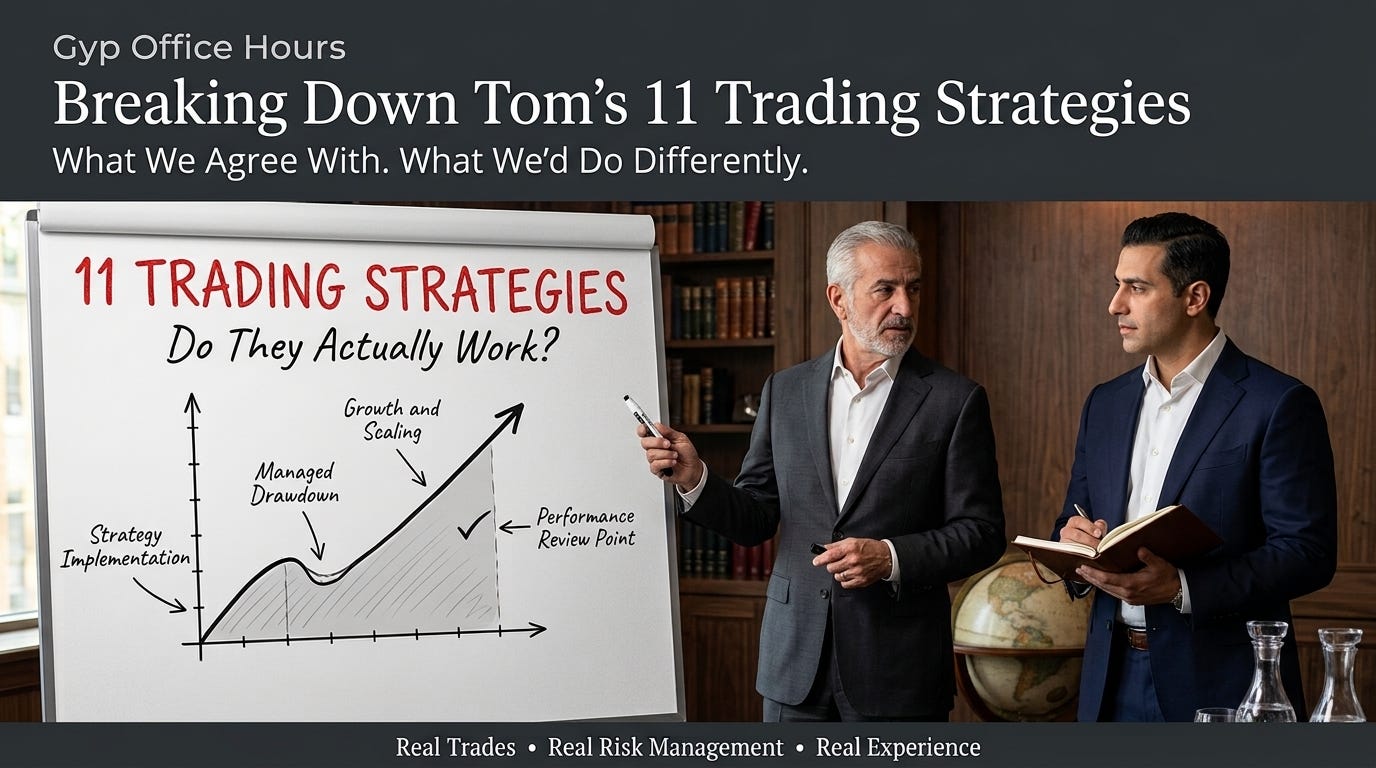
Tom Sosnoff has been trading options for 44 years. He founded thinkorswim, then tastytrade. If there’s a short list of the best options traders alive, he’s on it — and unlike most people on that list, he has spent decades explaining exactly how he does it, in public, for free.
He recently laid out the eleven strategies he has relied on for his entire career. Not complex ones. He calls them boring on purpose. Every one is chosen for two things: capital efficiency, and a high probability of profit.
Then he says something that stops you cold. The last two strategies on the list account for more than 70% of his lifetime profits.
Tomorrow we’re going to go through all eleven — what each one is, when he uses it, and the specific parameters he gives. And we’re going to be honest about which ones we run, which ones we don’t, and why.
The Details
Tomorrow — Thursday, August 13, 2026
2:00 PM Pacific · 3:00 PM Mountain · 4:00 PM Central · 5:00 PM Eastern
🔒 Members only. This one isn't going out to the free list — we'll have the portfolios open on screen and we'll be talking about real positions with real numbers.
Here is a Link to the Fabulous Original Video Tom produced: (Watch before the OH)
The Eleven, As He Groups Them
He splits them three ways: ways to get long, ways to get short, and ways to sell volatility.
Getting long
1. Short puts. His default. Out-of-the-money, 35–50 DTE, 16–22 delta, better than 80% probability of profit. Capital efficient, easy to adjust.
2. Jade lizard. A short put with a short call spread attached, around 40 DTE. The rule that makes it work: the total credit must exceed the width of the call spread, which removes the upside risk entirely.
3. Covered calls. Stock plus a short call, executed as one trade. He wants a low cost basis and high implied volatility, 40–60 DTE, 25–30 delta.
4. Short put spreads. Defined risk. Collect 30–35% of the width between the strikes.
5. Put ratio spreads. For oversold names. Buy a put outside the expected move, sell twice as many further out, structured for a net credit.
Getting short
6. Short call spreads. Call options carry skew and trade expensive, so he sells them just inside the expected move, 30–50 DTE.
7. Broken wing butterfly. Short deltas with protection built in against a move up. About a month out, and always for a net credit.
8. Unbalanced iron condor. A condor with a directional lean — the call spread wider than the put spread.
Selling volatility
9. Iron condor. The defined-risk strangle. Target 30–40% of the width in credit.
10. Short strangles. 16–20 delta, 45 DTE, and he wants implied volatility rank to be genuinely high. He calls this his absolute go-to.
11. Price reversion to the mean. Trading volatility’s own tendency to contract faster than it expands, or pairs trading two correlated products against each other.
Numbers 10 and 11 are the ones that made him most of his money.
Where You’ll Recognize Our Book
Here’s why this isn’t an academic exercise. Have the portal open during the session — you’ll be looking at live examples of six of his eleven while we talk, with the actual fills in front of you:
Short puts are the backbone of Portfolio 1 — the SPY ladder, the /MES ladder, the QQQ steps in P2. We closed the SPY September 715 and 735 puts on Monday for +$774 and +$899, keeping 77% and 70% of the credit.
Jade lizards we’ve run on AAPL, TSLA, NVDA and GLD this year. We’ll show you the credit-versus-width arithmetic on a real one and why it matters.
Covered calls — we closed a full one yesterday on GLD, and it’s the best teaching example we have, because the call leg lost $1,868 on its own and the trade still worked.
Broken wing butterflies are all over Portfolio 2, including two we built for effectively nothing in July.
Ratio structures run in the Black Swan sleeve — currently 15 long SPY 570 puts against 9 short 590s.
Mean reversion in volatility is the newest position in the book: long two Mini VIX futures with calls sold against them, settling next Wednesday.
