


A structural macro and technical thesis — and a tiny, convex way to play it
An educational thesis piece, not a recommendation.

Why this is different from “the yen is weak”
Everybody knows the yen is weak. That’s not the interesting part.
The interesting part is that this may not be a cyclical weakness that snaps back — it may be a regime change. The forces that kept the dollar-yen exchange rate (USD/JPY) trapped between roughly 80 and 120 for decades appear to have fundamentally broken. If that’s true, a move to USD/JPY 200 isn’t a wild outlier — it’s just the continuation of a trend that’s been running for over ten years.
That’s a big “if.” But the macro and the charts line up well enough that we put a small, defined-risk bet on it. Here’s the case, in plain English, followed by exactly what we did.
Part I — The technical picture
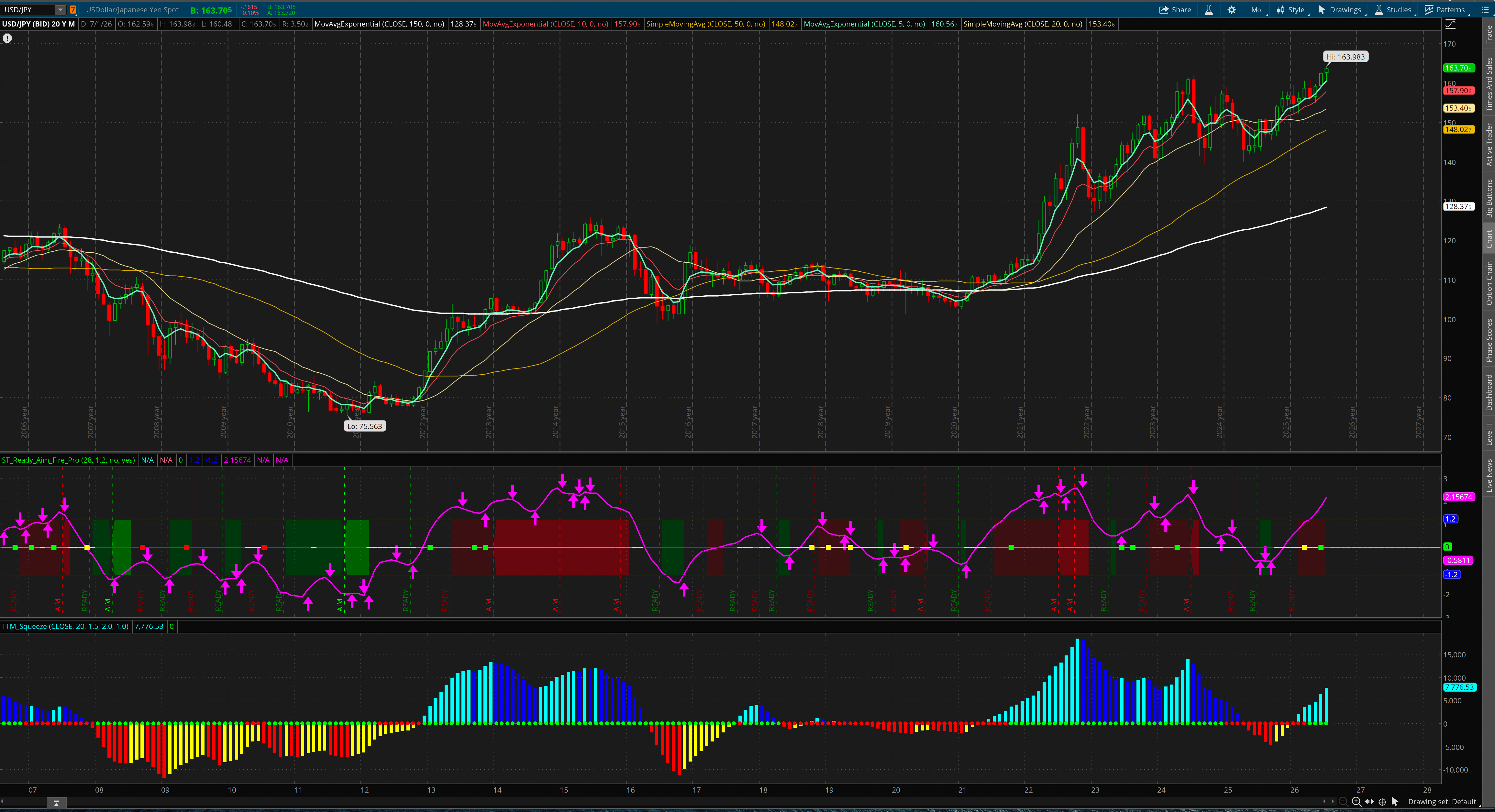
For years, the market treated about ¥110 per dollar as the “right” price — the level it should always drift back toward.
Instead, it blew straight through every line that was supposed to hold: 125 → 140 → 150 → 160. Each one was called “impossible” right up until it broke.
Here’s why that matters. When a price spends 30 years inside a range and then breaks above the top of it, there’s no history up there — no old highs, no prior resistance, nothing for the market to lean on. That’s called price discovery, and it tends to produce bigger moves than anyone expects, because there’s no obvious anchor telling buyers “this is too expensive.”
We’ve seen this movie before:
Gold breaking above its 1980 high — then running for years.
The Nasdaq breaking above its 2000 bubble peak — then tripling.
Bitcoin breaking above $20,000 — you know how that went.
Once a decades-long ceiling breaks, markets overshoot. On the long-term (monthly) chart, USD/JPY is doing exactly that: higher highs, higher lows, sitting above every major moving average, fresh all-time highs, momentum firing. There is simply no technical evidence the trend has ended. From the 2011 low near 75 to about 164 today, it’s already climbed more than 118%. Another 20–25% to reach 200 fits right inside the size of moves it’s already made.
Part II — The macro story: why the yen may keep falling
The chart is just the symptom. Here’s the disease.
1. The Bank of Japan is trapped. Japan’s government debt is one of the highest in the developed world — over 250% of GDP. When you owe that much, you can’t raise interest rates much, because even a small increase makes the interest bill on all that debt explode. So the central bank’s hands are tied. It can’t defend the currency the normal way (with higher rates) without blowing up its own budget.
2. The paradox — higher rates might make the yen weaker, not stronger. This is the counterintuitive heart of the case. Normally, higher rates attract money and lift a currency. But in Japan, a small rate hike:
knocks down the price of Japanese government bonds (hurting the banks and insurers that own mountains of them),
still doesn’t pay enough to be worth keeping your money at home.
So instead of pulling money in, a modest hike pushes money out — it damages the bond market without offering enough yield to keep Japanese savings in Japan. The BOJ is stuck between a rock and a hard place.
3. Thirty years of easy money created a giant “search for yield.” Japan has run zero rates, quantitative easing, and yield-curve control for almost three decades. That crushed returns at home and trained every Japanese pension fund, insurer, bank, and company to send money overseas looking for a better return. Those investors now hold trillions of dollars of foreign assets. As long as U.S. rates sit well above Japanese rates, the incentive is relentless: borrow yen, buy dollars, buy foreign bonds and stocks. Every time they do it, it pushes the yen down a little more.
4. A weak yen is a feature, not a bug — for corporate Japan. Here’s the uncomfortable truth: a falling currency is a transfer of wealth. It quietly punishes households, wage-earners, and savers (their money buys less), while it rewards exporters, multinationals, and stockholders (their overseas earnings are worth more yen). That’s why you can get the strange-looking combination of a soaring Nikkei and a sinking yen at the same time — a weaker currency inflates corporate profits even as it squeezes the average family. It’s happened before: the U.K. stock market took off after the pound crashed out of the ERM in 1992.
5. The “cash boulder.” For 30 years, deflation rewarded Japanese households and companies for hoarding cash — prices fell, so cash gained value just sitting there. They piled up an enormous stockpile of savings. But now inflation and a falling yen have flipped that: holding cash is quietly bleeding value every day. If even a fraction of that “cash boulder” starts rolling — out of cash and into stocks and foreign assets — it becomes self-reinforcing: a stronger Nikkei, a weaker yen, feeding on each other.
6. The mindset shift. This is the piece that ties it together. Japan is coming out of three decades of deflation into inflation — but wages haven’t caught up. For the first time in a generation, doing nothing with your money costs you. If Japanese savers slowly internalize that and change their behavior, they redirect a huge pool of capital toward exactly the assets that weaken the yen further.
None of these is a single dramatic catalyst. That’s the point. It’s the convergence — a technical breakout, a trapped central bank, relentless capital outflows, and a once-in-a-generation change in how a whole country thinks about saving — that makes the case coherent, even if the path there is bumpy.
Why 200 is plausible (and why we still call it low-probability)
From ~164 today, USD/JPY 200 is about 22% more. In a currency that’s already run 118% off its lows, that’s not extraordinary — it’s ordinary, for a secular trend.
But — and this matters — plausible over years is not the same as likely in the next few months. This could take a long time, and it could reverse violently along the way. Which is exactly why we’re not betting the farm on it. We’re betting a rounding error, in a structure that can’t lose more than we put in.
What could kill the thesis (the honest risks)
A much more aggressive BOJ that’s actually willing and able to hold materially higher rates.
A sharp U.S. recession that forces the Fed to cut hard, shrinking the rate gap that’s driving the outflows.
Coordinated currency intervention by Japan, especially if the fall turns disorderly.
A global risk-off panic that sends money rushing back into the yen (its old role as a safe haven).
Any of these could stall or reverse the move. We respect all of them — which is why the position is tiny.
The Trades
🔒 The specific positions and the payoff math below are for Grow Your Pile members.
