


I reviewed the major market developments from this week with the same GYP filter we use every Friday: what actually matters for positioning, risk, and opportunity going into next week?
Last week the story was a weak jobs report that stocks loved and bonds didn’t. This week stocks went further and set a new all-time closing high on Tuesday. Bonds still weren’t buying it. The 10-year approached 5.35% before it backed off, Brent finished near $105, and the AI conversation moved from how big it gets to who’s paying for it.
Here are the five stories I think matter most for traders and investors.
The Five Stories That Moved Markets
1 · The S&P 500 Hit New Records — Despite Everything
The S&P 500 reached a new all-time closing high on Tuesday, its first since mid-August. The Nasdaq also established records as investors returned to AI leaders, including NVIDIA and Microsoft.
Perhaps more importantly, market participation began improving. The equal-weighted S&P 500 broke a seven-week losing streak, suggesting the rally was no longer entirely dependent on mega-cap technology.
Trader Take: The primary trend remains bullish, and improving breadth is encouraging. For options traders, this supports maintaining some positive delta while avoiding excessive buying-power utilization near record highs. Look for opportunities to sell puts on quality stocks during pullbacks rather than chasing extended rallies.
Investor Take: New highs aren’t inherently bearish. Broadening participation makes the rally healthier, but with valuations elevated, disciplined portfolio rebalancing and diversification remain important.
What the closing numbers add. Charlie Bilello put a number on Tuesday’s record:
“The S&P 500 closed above 7,800 today for the first time, hitting its 28th all-time high of the year.”
By Friday’s close the index was at 7,811.54. SPY finished the week up 1.16%, 0.39% under its 52-week high.
The breadth point shows up on the sector board. Nine of the eleven sectors finished the week higher, and technology finished last, down 0.52%. Utilities, staples and energy each gained more than 3.5%. A week with a record close in it and tech at the bottom of the list is what broadening looks like. MT Newswires’ post-close headline on Friday said it this way: “US Equity Indexes Rise This Week as Broad-Based Rally Helps Offset Tech Declines …”
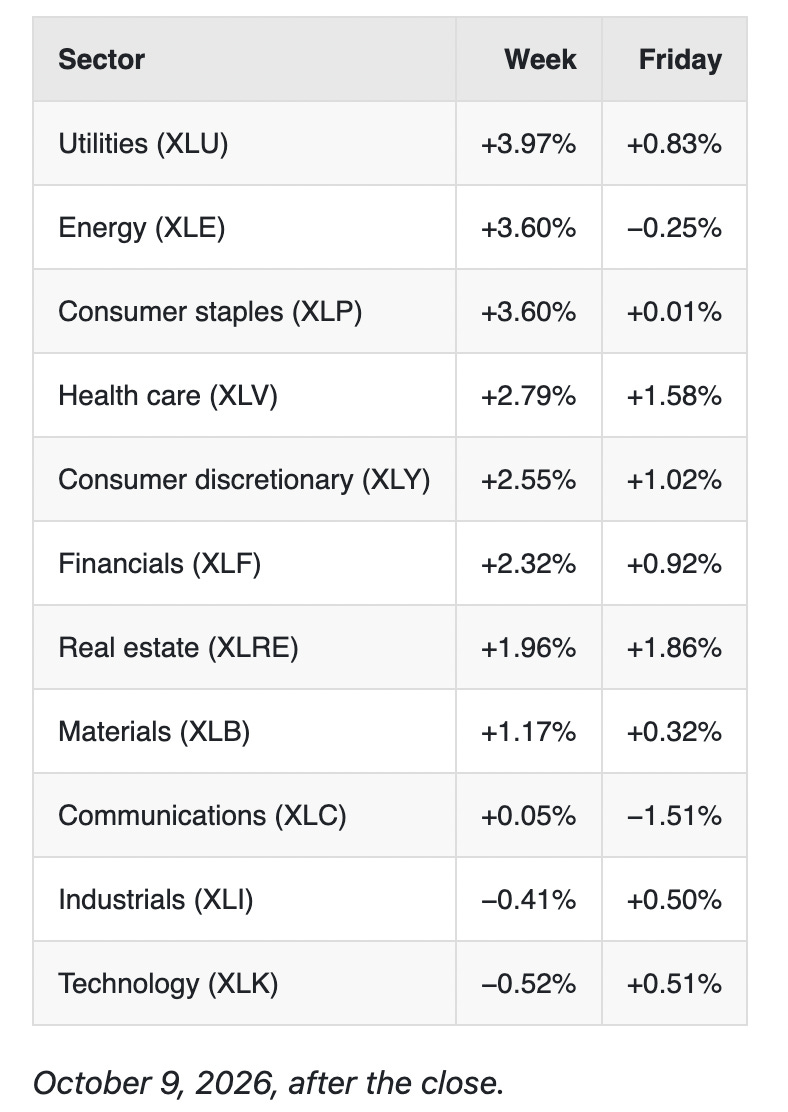
Small caps were the exception. IWM finished the week down 0.92%, even after a green Friday. Seabreeze Partners titled a Wednesday commentary “Another Day That the Russell Isn’t Crowing,” and Doug Kass shared it.
Sentiment only caught up a little. Liz Ann Sonders posted Thursday that AAII bulls “jumped to 40.3% vs. 34.6%” for the week ending October 7, with bears down to 39.0% from 46.5%. Bulls barely ahead of bears in a week with a record close isn’t a crowd that’s gotten carried away.
2 · Treasury Yields Are Becoming the Market’s Biggest Risk
This may be the week’s most important macro development.
The 10-year Treasury yield approached 5.35%, its highest level since 2002, before retreating. Concerns about government borrowing, persistent inflation, and enormous AI-related financing requirements continued putting pressure on global bond markets.
Higher yields increase borrowing costs and make Treasury securities more competitive with stocks. That is particularly important for technology companies whose valuations depend heavily on future earnings.
Trader Take: Keep the 10-year Treasury yield on your screen alongside SPX and QQQ. If yields continue breaking higher, expensive technology stocks could face valuation pressure. If yields stabilize or decline, that could provide another catalyst for equities.
Investor Take: With Treasuries yielding above 5%, investors have meaningful alternatives to equities. This environment favors businesses with strong free cash flow, reasonable valuations, and manageable debt.
Where yields actually finished.
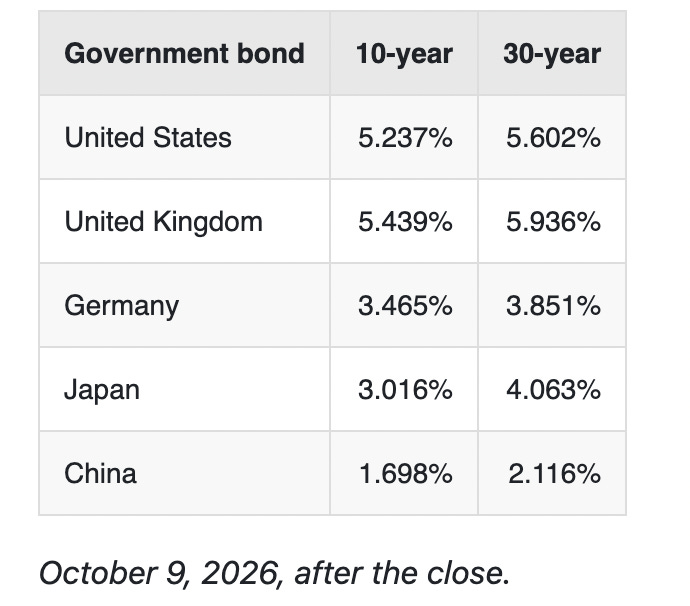
The US 10-year closed Friday at 5.237%. That’s the “before retreating” above, with a number on it. It wasn’t only an American retreat, either. Wednesday’s wire had the UK 30-year gilt at 6.034%, its highest since 1998, and it closed the week at 5.936%. Bilello noted the same day that India “hiked rates for the first time since 2023, 25 bp increase up to 5.50%.”
Bilello again, on Thursday, listed the average 30-year mortgage rate by decade and ended with “Today’s Rate: 7.40% (highest since Nov 2023)”. Same day on the wire, the Congressional Budget Office’s Swagel said the fiscal trajectory is putting pressure on rates, and also that the impact of debt concerns on yields is small.
Not everyone thinks higher yields are a problem for stocks. Doug Kass, on Friday, relaying Tom Lee on CNBC:
“’Heads I win, tails I win’ - so says Tom Lee about higher interest rates.”
Kass’s post goes on to say Lee “says higher rates are great for equities because consumers’ interest income will …” and it’s cut off there. That’s the opposite argument from the one above, where Treasuries get more competitive with stocks. I’m leaving both on the page. Portfolio 1 sold a TLT put into all of this on Friday, and it’s below.
3 · The AI Boom Is Entering a New Phase: Who Pays for It?
AI remains one of the market’s strongest long-term investment themes, but the conversation is changing.
This week, reports of another wave of enormous AI-related corporate borrowing raised concerns about how much capital will be needed to build the next generation of data centers and computing infrastructure.
Investors also scrutinized reports questioning whether OpenAI’s revenue was meeting earlier projections, contributing to volatility in technology shares.
The central question is evolving from “How big will AI become?” to “Will the companies spending hundreds of billions earn an adequate return on their investment?”
Trader Take: AI is no longer a trade where every company automatically benefits. Watch relative strength in semiconductors, memory, networking, and infrastructure, but pay particular attention to earnings reactions and capital-spending announcements.
Investor Take: The AI revolution may be real while individual investments still disappoint. Focus on companies converting AI demand into revenue, cash flow, and attractive returns on capital rather than relying exclusively on growth projections.
How big the AI trade has gotten, and who’s paying. Jim Bianco posted this on Thursday, and Danielle DiMartino Booth reposted it Friday with one word, “Perspective.”:
“If SpaceX ($SPCX) was in the $SPX now, AI-related stocks would be 51% of the index. With Anthropic and OpenAI coming public, add them to the $SPX in 2027 and AI would be ~55% of the $SPX. The last time a single theme was >50% of the $SPX was the railroads in the 19th century.”
He was building on Alex Malitas, who wrote Wednesday that AI-related stocks, by the JPM basket, “now make up 49% of the S&P 500” and that “Those same 41 companies account for about two-thirds of the S&P 500’s year-to-date market cap change.” Those are their numbers, not ours.
DiMartino Booth had already put the other side of it on Thursday:
“AI will change something! But it’s more likely to ‘just’ be tacking an extra trillion onto the $16 trillion corporate debt market. Whee!”
Half the index on one theme, and the theme being paid for with debt.
My Trader Take says AI isn’t a trade where every company benefits anymore. The week agreed:
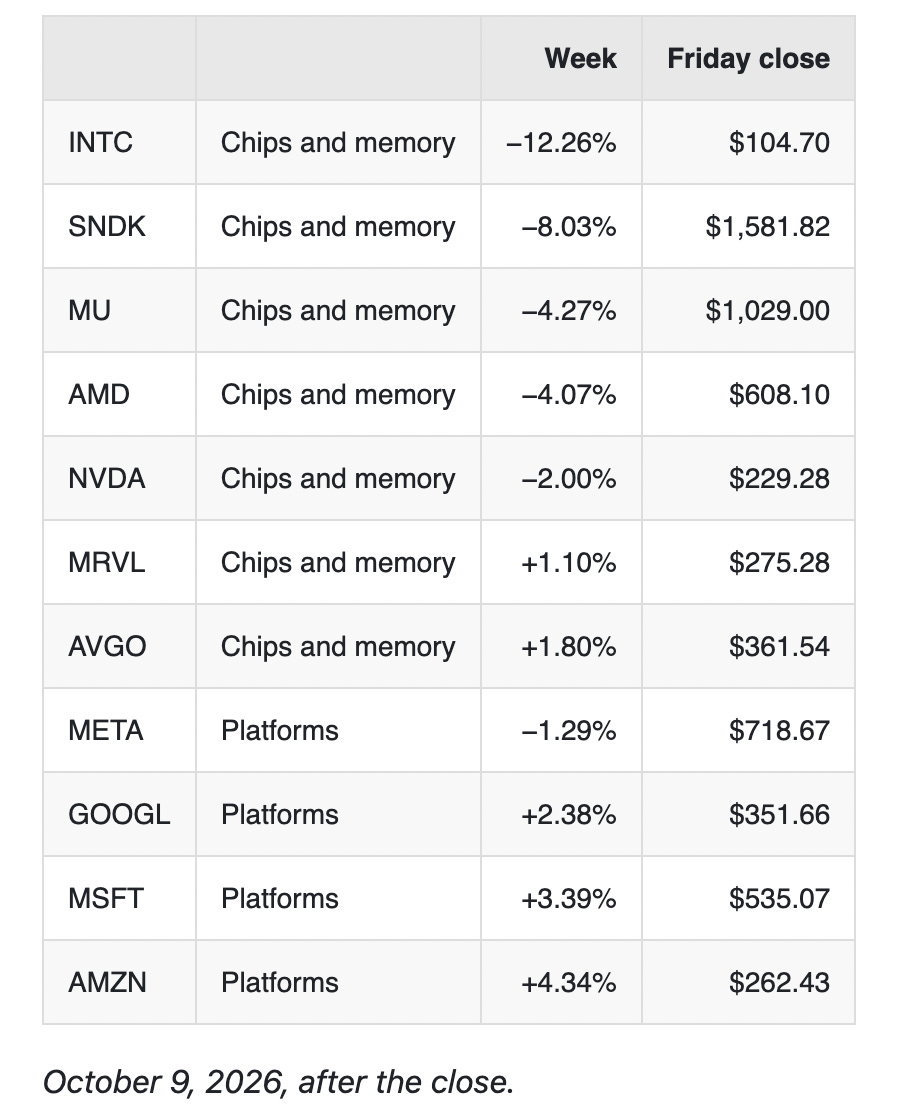
Five of the seven chip and memory names fell on the week, Intel by 12.26%. Three of the four big platforms rose.
4 · Oil Surged Again — And Geopolitics Remains a Major Inflation Risk
Oil prices experienced another volatile week as Middle East tensions intensified. Brent crude surged more than 4% Thursday, briefly moving above $105 per barrel.
Friday brought some relief after President Trump indicated the United States would not launch attacks against Iran before November’s midterm elections. However, Brent still settled near $105, illustrating how much geopolitical risk remains embedded in energy prices.
This matters because higher oil prices affect much more than energy stocks. They influence transportation costs, consumer spending, corporate margins, and inflation expectations.
Trader Take: Energy remains an attractive sector to monitor, but crude oil is extremely headline-sensitive. Rather than chasing sudden price spikes, look for more disciplined entries in energy equities. Airlines and transportation companies could remain vulnerable if fuel prices stay elevated.
Investor Take: Persistent $100-plus oil makes the Federal Reserve’s job more difficult. Lower energy prices would be a welcome development for inflation, consumer spending, and equity valuations.
Thursday’s spike and Friday’s close. MT Newswires had Thursday’s cause before the bell: “US Equity Futures Fall Pre-Bell as Oil Prices Rise After Trump Says He Does Not Want Iran Deal.” Friday’s comment above was a different one, about no attacks before the midterms. Brent closed Friday at $104.36, eight cents up on the day and 2.06% higher on the week. WTI finished at $91.55, and energy stocks (XLE) gained 3.60% on the week.
The supply data pointed the same way. Wednesday’s EIA report, on First Squawk, showed US crude inventories down 3,186K against an expected build of 1,718K. The same morning UBS raised its December oil forecasts by $5 a barrel, citing declining inventories and escalating attacks in the Strait of Hormuz.
On the airline point in my Trader Take, one data point came through Friday. DiMartino Booth, relaying Adam Josephson on Delta’s miss and cut:
“Its premium cabin revenue continues to grow rapidly, well in excess of its main cabin revenue, such that the former is now higher than the latter”
The post doesn’t say fuel caused the miss, so I won’t either. What it does show is the K-shape: the front of the plane is still spending.
5 · SpaceX Just Shook Up the Telecommunications Industry
One of the week’s biggest company-specific developments came Friday when SpaceX agreed to acquire approximately $8 billion of low-band wireless spectrum, strengthening its ambitions to compete directly with traditional mobile carriers through Starlink Mobile.
The announcement triggered sharp selling in telecommunications stocks. T-Mobile declined more than 13% during Friday’s session, while Verizon and AT&T also suffered substantial losses.
Interestingly, cellular tower companies such as American Tower and Crown Castle rallied as investors considered whether satellite connectivity might actually increase demand for complementary terrestrial infrastructure. The spectrum acquisition still requires regulatory approval.
Trader Take: This creates an interesting divergence. Traditional wireless carriers are being repriced for potential competition, while tower operators are attracting buyers. Watch for stabilization before selling puts in beaten-down telecom stocks; a large one-day decline doesn’t necessarily mean the selling is finished.
Investor Take: Satellite-to-phone connectivity could become a significant long-term disruption to traditional wireless services. Investors should distinguish between companies whose business models face new competition and infrastructure providers that could benefit from expanding connectivity.
Communications was the worst of the eleven sectors on Friday, down 1.5%, and one of only two that closed red. Energy was the other.
The spectrum deal wasn’t SpaceX’s only big bill this week. Wednesday’s wire (Walter Bloomberg) carried an FT report that SpaceX is seeking $40 billion of financing to buy NVIDIA chips, and SPCX, which is SpaceX’s own stock, was down 1.5% on the same wire item. So in one week SpaceX was reported to be seeking $40 billion for chips and agreed to spend about $8 billion on spectrum. It’s also the name in the middle of Bianco’s arithmetic in story 3.
Where The Year Actually Stands
The six benchmarks on the members dashboard.
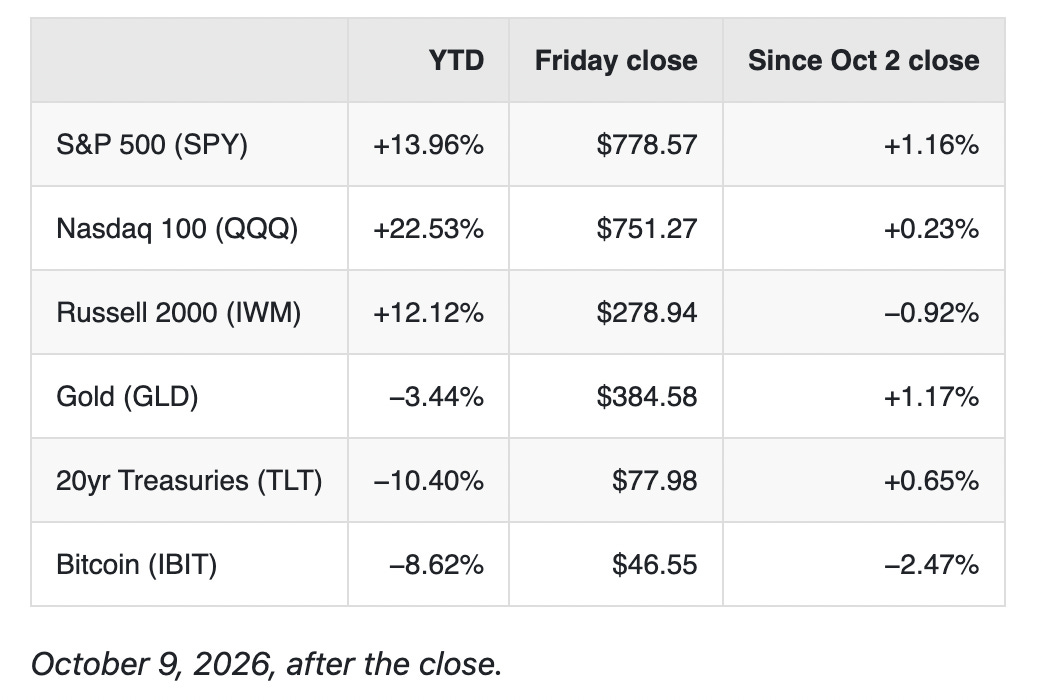
QQQ still leads the year at +22.53% and TLT still trails at −10.40%. The week didn’t look like the year. Gold had the best week of the six, by a hundredth of a point over SPY, and SPY’s 1.16% was about five times QQQ’s 0.23%. TLT finished higher too. Bitcoin had the worst week, IBIT down 2.47%, and IWM was the only other one in the red.
Trader Take: SPY beating QQQ while IWM fell is broadening at the top of the market, not all the way down. Selling a put on the S&P and selling one on small caps were different bets this week, and the scorecard put about two points between them.
Investor Take: TLT’s −10.40% is what long-bond yields above 5% look like in a bond fund’s price. The price fell, so the income went up. Anyone buying long bonds now is buying that income, and taking the price risk that came with it this year.
What We Actually Did
Six alerts, twenty-four tickets, two books. Portfolio 1 and Portfolio 2 booked +$5,201.50 of realized profit, gross, and that number already has three losing lines in it, worth −$1,598.00 between them. On Friday both books sold a put again, $396.00 of credit between the two. No Portfolio 3 alert went out this week.
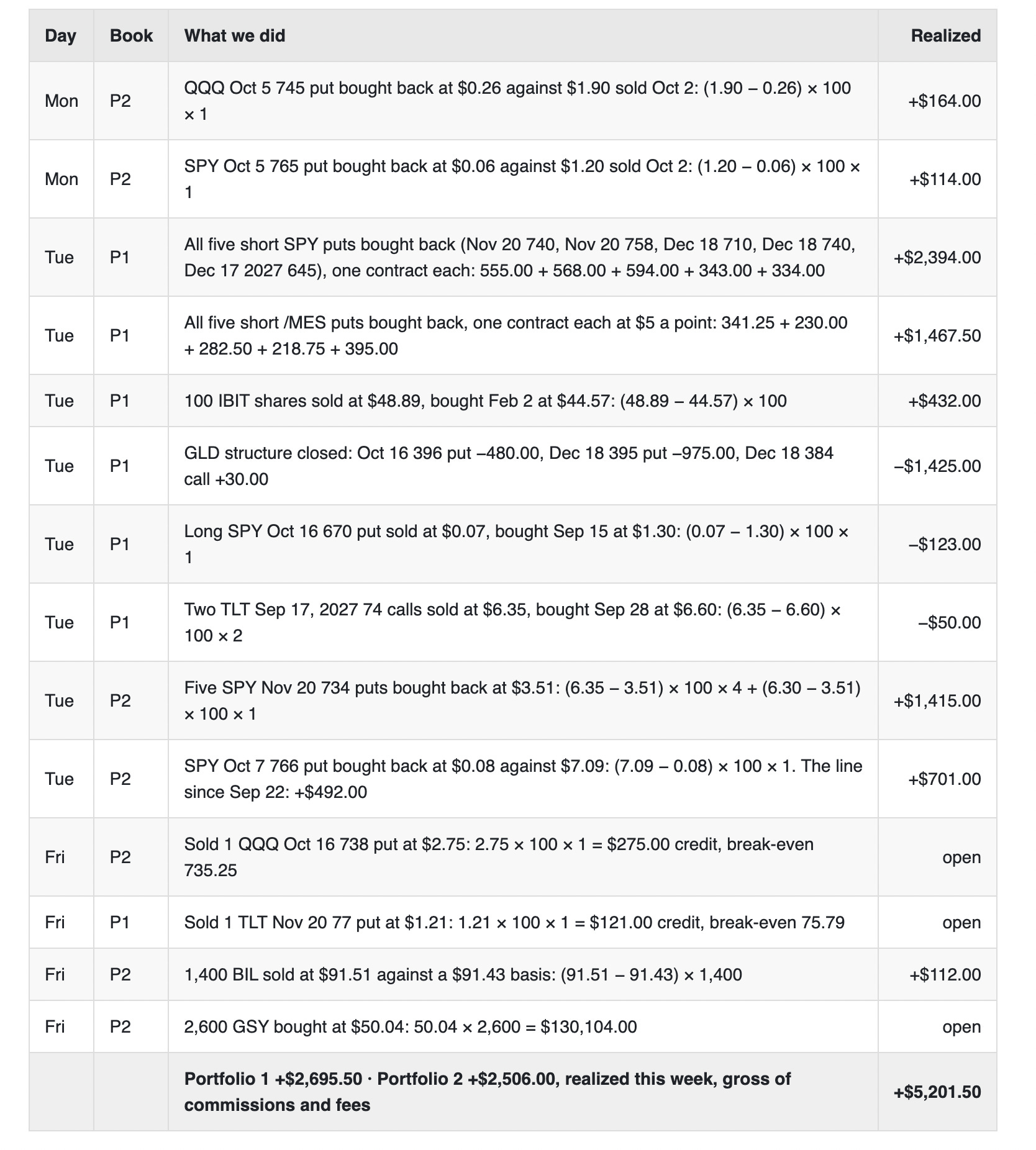
Monday closed what last week’s letter left open. The SPY 765 and QQQ 745 puts Battista sold on October 2 to “have some money working over the weekend” came off Monday morning at 95.00% and 86.32% of their credit.
Tuesday was the clean house. Both alerts gave the same reason: “We have a big announcement at Thursday’s Office Hours, and we wanted the portfolio as clean as possible going into it.” Clean didn’t mean empty. Portfolio 1 kept its SPX January 2027 box, one long yen put and its BIL. Portfolio 2 kept the stocks it bought with trading profits, plus BIL and SGOV. The announcement is at the end of this letter.
Last week I showed you Portfolio 1’s GLD structure $1,817.00 underwater on the mark. On Tuesday it closed for a realized loss of $1,425.00. GLD was $382.18 on Tuesday morning. It closed Friday at $384.58, so gold went up after we closed it. Bitcoin went the other way: Portfolio 1 sold its IBIT shares at $48.89 on Tuesday, and IBIT closed Friday at $46.55. Neither one was a view on gold or bitcoin. The reason for both closes was the announcement, and when you close for a reason other than price, you take whatever the price does next.
The other two losers were small: a long SPY put bought on September 15 that came off at seven cents, −$123.00, and two TLT September 2027 calls, −$50.00.
The SPY October 7 766 put made $701.00 on the contract Portfolio 2 bought back Tuesday. That position had been rolled four times since September 22, and across the whole line it made $492.00. The table counts the $701.00 because that’s what was realized this week. The $492.00 is the line’s honest total.
Friday the books went back to work. Battista sold one QQQ October 16 738 put for $2.75, and he picked the expiry on purpose: “when I looked across the weekly expiration cycles, the seven-day options were carrying the highest implied volatility.” He also noticed that “VX futures weren’t moving much.” The VIX closed the week at 14.84. QQQ closed at $751.27, against a break-even of 735.25.
Portfolio 1 sold one TLT November 20 77 put for $1.21. The note on the alert didn’t dress it up: “trying to catch a falling knife on TLT,” and “could be in the house of pain soon.” TLT closed Friday at $77.98, above the 77 strike, with a break-even of 75.79.
And Portfolio 2 moved its parked cash from BIL to GSY, all 1,400 BIL shares out at $91.51 for +$112.00 over the $91.43 they cost, and 2,600 GSY in at $50.04. The alert called it a cash-management move, not a market call: GSY at 4.21% against BIL’s 3.45%, by the figures in that alert.
Trader Take: The clean house wasn’t a market call, and Friday shows it. Once the announcement was done, each book sold one put, one contract each, and the QQQ expiry was picked by where the implied volatility was richest, not by habit. Both are uncovered and both are open.
Investor Take: Three lines lost $1,598.00 this week, and we closed all three on purpose. The GLD one is the lesson. A mark we published last week became a realized loss this week, and then gold rose. That’s the cost of closing for a reason other than price, and it belongs in the record next to the winners.
Bottom Line
The week in a few numbers: a record close for the S&P on Tuesday, a 10-year that got near 5.35% before it backed off, Brent near $105, and T-Mobile down more than 13% in a day after SpaceX agreed to buy spectrum.
For traders, I’m constructive and careful at the same time. The trend is up and breadth is improving, so I want some positive delta, but not a lot of buying power used up near record highs. I’d rather sell puts on quality into pullbacks than chase.
For investors, Treasuries above 5% are real competition for stocks again, and that raises the bar. Free cash flow, reasonable valuations and manageable debt are what I want to own more of. New highs aren’t a reason to sell, and they aren’t a reason to stop rebalancing.
So the setup for next week comes down to one question: can stocks keep making records with the 10-year this close to 5.35%?
If yields stabilize or come down, that could be the next catalyst for equities, tech included.
If yields keep breaking higher, expensive technology is where I’d expect the pressure.
GYP AutoTrade
Thursday’s Office Hours was the announcement the clean house was for: GYP AutoTrade, powered by PeakBot. AutoTrade is an optional service we offer because members asked for it, and offering it isn’t a recommendation to use it. Following the alerts and placing the trades yourself is just as valid.
If you turn AutoTrade on, PeakBot’s software sends our trades to your connected broker automatically, and your broker places them. You still keep an eye on your own account. It works with Schwab, Tradier and tastytrade, and you choose Portfolio 1, Portfolio 2 or both. It’s $100 a month for GYP members and $250 a month for non-members.
Members can use the launch this PROMO CODE link: https://growyourpile.peakbot.com/lp/gyp-launch-promo-member
Grow Your Pile has a revenue-sharing agreement with PeakBot, so we earn a share of AutoTrade subscription fees.
Disclaimer
This is not investment advice. Nothing in this letter is a recommendation to buy or sell any security. Grow Your Pile and Squared T Capital publish what we do in our own accounts for education. Options involve substantial risk and are not suitable for every investor. A short put can require you to buy stock at the strike price and can lose more than the premium collected. Past results do not predict future results. Do your own work and consider speaking with a licensed advisor about your circumstances.
The QQQ October 16 738 put and the TLT November 20 77 put sold on Friday are uncovered short puts and both remain open, so their outcomes are unknown. Assignment would mean buying 738 × 100 × 1 = $73,800 of QQQ or 77 × 100 × 1 = $7,700 of TLT; those are notional figures, not margin, and the credit collected on a short put is never a measure of what it can lose. GSY is an exchange-traded fund and its price can fall. /MES options are $5 per point and are SPAN-margined, and futures involve leverage. AutoTrade is optional; automation doesn’t take the risk out of trading, and results in your account can differ from ours because of timing, fills, position size and your own settings. Every dollar figure in this letter is gross of commissions and fees. Margin requirements vary by strike, expiry, volatility, broker and margin regime, and your own broker’s number is the one that matters.
Past performance is not indicative of future results, and results shown are those of our own accounts and are not representative of any subscriber’s results. Read the Characteristics and Risks of Standardized Options before trading.
Tony Rihan and Tony Battista Grow Your Pile · Squared T Capital
Every options trade in Portfolio 1 and Portfolio 2 goes out win or lose, with entry, exit and running P&L. Portfolio 3 publishes its full weights. All of it is at growyourpile.com.