


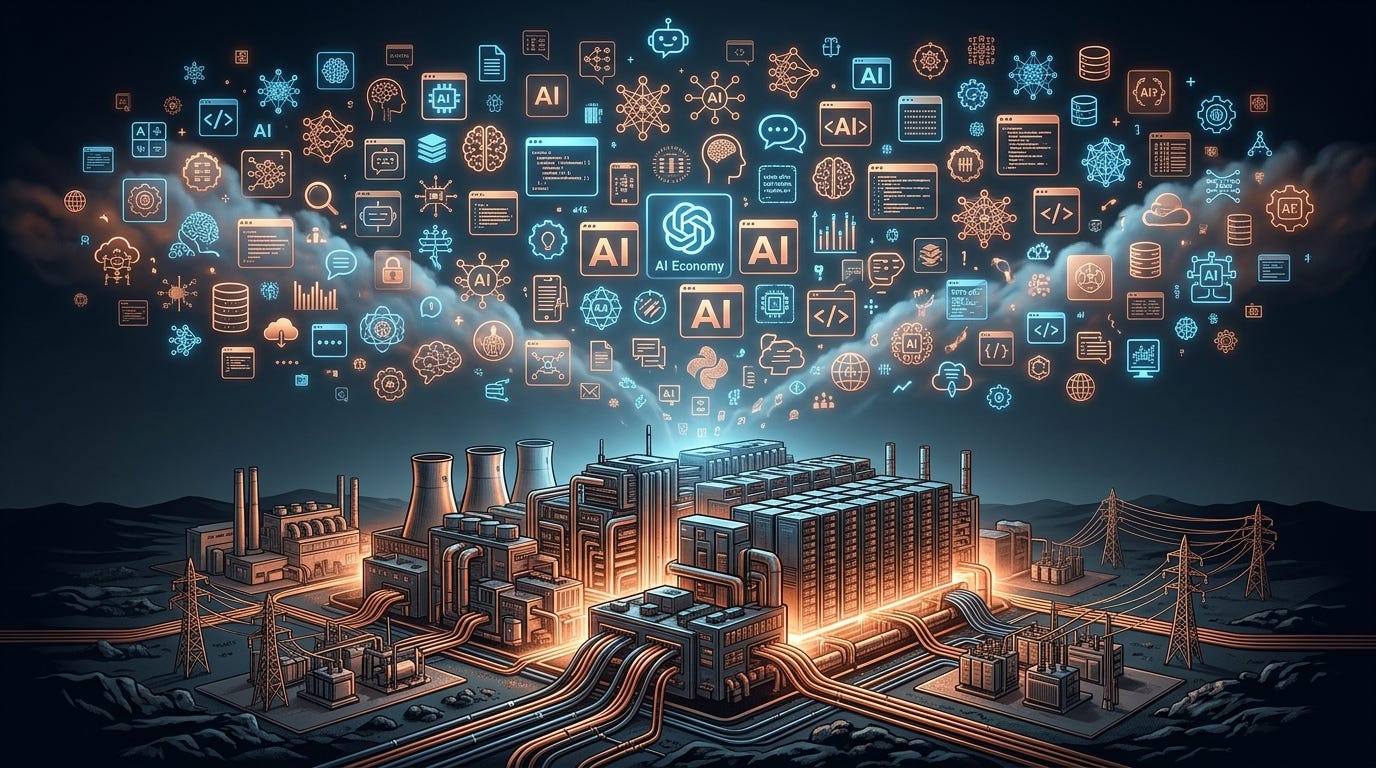
Artificial Intelligence is often discussed as if it’s just another technological upgrade — a better search engine, a smarter chatbot, a productivity tool for coders.
But that framing misses the real economic shift underway.
AI isn’t just changing what software can do. It’s changing where value exists in the technology stack.
For the last twenty years, software companies were the crown jewels of the market. High margins, recurring revenue, minimal physical assets, and the ability to scale globally with relatively little capital.
But AI is starting to change that equation.
Software is becoming more abundant.
Infrastructure is becoming more scarce.
And when scarcity changes, capital follows.
Understanding this shift is becoming one of the most important investment frameworks of the next decade.
Markets Don’t Pay You for Belief — They Pay You for Updating
One of the biggest mistakes investors make is confusing narratives with market behavior.
The news always provides an explanation for why markets moved. But the truth is often simpler:
Price usually moves before the story is written.
Markets today are heavily influenced by systematic flows, positioning, and algorithms reacting to patterns in real time.
This is why traders often say:
Don’t trade the story. Trade the behavior.
A single rally means very little. Markets can bounce for many reasons — short covering, positioning resets, temporary relief.
But consistent behavior tells you something different.
If markets allow buyers to hold gains multiple days in a row, it suggests selling pressure is easing.
If every rally is immediately sold, the market is telling you risk appetite hasn’t returned yet.
For investors, the lesson is simple:
Watch what markets do, not just what headlines say.
Confirmation matters more than conviction.
This principle becomes even more important during structural shifts like the one AI is creating.
AI Is Changing the Economics of Software
For decades, software had one of the best business models in history.
Companies could:
Build software once
Sell subscriptions indefinitely
Scale globally
Maintain extremely high margins
Require relatively little physical infrastructure
This is why the market placed such high valuations on software companies.
They were effectively toll booths on the digital economy.
But AI introduces a new dynamic.
Many tasks software companies charged for — writing code, analyzing data, generating reports, drafting documents, automating workflows — can now increasingly be handled directly by AI systems.
That doesn’t mean software disappears.
But it does mean pricing power can weaken.
If customers can replicate part of a software product using AI tools at a lower cost, they start asking difficult questions:
Why am I paying this subscription?
How much of this product can AI replace?
Do I need this tool at all?
Even small pressure on pricing or growth expectations can dramatically affect stock valuations.
That’s why many software companies are experiencing what markets call multiple compression.
The business may still be profitable.
But investors are paying less for each dollar of revenue.
The New Scarcity: Infrastructure
While software becomes easier to replicate, something else is becoming more valuable.
The infrastructure that powers AI.
AI isn’t just code.
It’s computation.
And computation requires massive physical systems.
AI runs on a stack of real-world infrastructure:
Data centers
Electricity
High-performance chips
Cooling systems
Power transformers
Fiber optic networks
High-speed interconnects
Every time someone interacts with an AI model, enormous amounts of computation take place behind the scenes.
This is where the economic shift begins.
Software scales instantly.
Infrastructure does not.
Building new data centers can take years.
Expanding power grids requires regulatory approval, construction, and transmission capacity.
Large power transformers often have lead times of 18–24 months.
Fiber networks take years to deploy.
These constraints create scarcity.
And scarcity creates pricing power.
The AI Stack: Where Value May Move
To understand how this shift may play out, it helps to visualize the AI ecosystem in layers.
Layer 1: Power and Electricity
AI data centers consume enormous amounts of electricity.
Large facilities can require 100–300 megawatts of power — equivalent to the energy demand of tens of thousands of homes.
Electricity availability may become a major bottleneck.
Layer 2: Data Centers
Data centers are the factories of the AI economy.
They house thousands of GPUs and specialized chips used for training and running AI models.
Building them requires land, power access, cooling systems, and enormous capital investment.
Layer 3: Chips and Accelerators
Semiconductor companies producing high-performance AI chips sit at a critical part of the stack.
Demand for computing power continues to grow as AI models expand.
Layer 4: Networking and Fiber Optics
AI clusters must communicate at extremely high speeds.
This requires:
Fiber optic cables
Optical transceivers
High-speed connectors
Data center interconnect systems
Without these networks, data centers cannot operate efficiently.
Layer 5: Cloud Platforms
Hyperscalers — companies operating massive cloud platforms — provide access to computing power for businesses and developers.
They sit between infrastructure and application developers.
Layer 6: Application Software
This is where traditional software companies operate.
These businesses still matter, but they may face greater competition and margin pressure as AI tools evolve.
The Market’s Fear: Overspending
Some investors worry that companies building AI infrastructure are spending too aggressively.
Cloud providers are investing hundreds of billions of dollars into:
data centers
chips
networking infrastructure
AI research
If supply eventually exceeds demand, returns on these investments could decline.
That risk is real.
But infrastructure buildouts often look excessive during early phases.
History provides examples:
Railroads in the 1800s
Fiber networks in the early internet era
Mobile networks in the smartphone boom
Infrastructure frequently appears overbuilt before demand catches up.
What This Means for Investors
No one can predict exactly how the AI economy will evolve.
But several useful principles emerge from this shift.
1. Pay Attention to Scarcity
Markets reward assets that are difficult to replicate.
If AI makes software easier to produce, scarcity may shift toward the physical infrastructure supporting computation.
2. Avoid Narrative Traps
Popular investment stories often attract the most crowded trades.
When everyone believes the same narrative, risk increases.
The best opportunities often appear where markets haven’t fully adjusted yet.
3. Watch Market Behavior
Price action often reveals information before headlines do.
Markets can signal whether investors are embracing or rejecting a thesis.
4. Expect Dispersion
Technological shifts rarely lift all companies equally.
Some businesses thrive.
Others stagnate.
Some disappear entirely.
The AI transition may produce large gaps between winners and losers.
5. Stay Flexible
One of the most valuable skills in investing is the ability to update beliefs as new information arrives.
The market rewards adaptability more than certainty.
How to Position for the Infrastructure Shift
If you believe scarcity is moving from software to infrastructure, here are GYP-style trades to consider:
Trade #1: Infrastructure Over Software (Pairs Trade)
Instead of picking individual winners, express the thesis as a relative value trade:
Long Infrastructure:
Utility/Power: NEE (NextEra Energy), AEP (American Electric Power)
Data Centers: EQIX (Equinix), DLR (Digital Realty)
Networking: JNPR (Juniper Networks), CSCO (Cisco)
Short (or Underweight) Software:
High-multiple SaaS companies vulnerable to AI disruption
Example: Reduce exposure to CRM, productivity tools being AI-replicated
Structure: Dollar-neutral pairs (long $10K infrastructure, short $10K software)
Why: Captures the relative shift without directional market risk
Trade #2: Sell Puts on Infrastructure (GYP Cost Basis Reduction)
If you want to own infrastructure stocks, get paid to wait:
Example:
Sell NEE (NextEra) $60 puts 45-60 DTE
Collect premium while waiting for entry
If assigned, your cost basis is $60 minus premium collected
Why: Classic GYP — reduce cost basis, stack probability
Trade #3: Covered Calls on Utility Positions
Own power/utility stocks but reduce cost basis weekly:
Example:
Buy 100 shares NEE @ $65
Sell weekly $68-70 calls for $0.50-1.00
Collect premium every week, lower cost basis
If assigned, you made 4-7% + premiums
Why: Infrastructure stocks are stable, perfect for income strategies
Trade #4: Long Call Spreads on Data Centers
Instead of buying EQIX or DLR outright:
Bull Call Spread:
Buy EQIX $800 call / Sell $850 call
Cost: ~$20-25 debit
Max profit: $25-30 if EQIX above $850
Breakeven: $820-825
Why: Defined risk, lower capital, expresses thesis efficiently
“What NOT to Do”
❌ Don’t Just Buy “AI Infrastructure” ETFs Blindly
Many AI ETFs are:
Still heavy in software (NVDA, MSFT, GOOGL)
Not pure infrastructure plays
High fees
Momentum-chasing
Do your homework on holdings.
❌ Don’t Assume ALL Software Dies
This isn’t “short all SaaS.”
Some software companies will:
Integrate AI and maintain pricing power
Own irreplaceable data/networks
Serve regulated industries AI can’t disrupt
The thesis is relative shift, not absolute destruction.
❌ Don’t Over-Concentrate
Infrastructure is capital-intensive and regulated.
These aren’t moonshots. They’re steady compounders.
Size accordingly: 10-20% of portfolio max, not 50%+.
Counterargument: What If They’re Overbuilding?
Yes, cloud providers are spending $200B+/year on infrastructure.
But:
AI compute demand is growing 3-4x per year
Lead times are 18-24 months (you can’t pivot fast)
Historical infrastructure buildouts ALWAYS looked excessive early
The risk: If AI adoption slows OR efficiency gains reduce compute needs, returns suffer.
How to hedge:
Don’t go all-in on one thesis
Use spreads/pairs trades (infrastructure vs software)
Take profits on big winners (50% rule applies)
This isn’t “buy and hold forever.” It’s “scarcity is shifting — position accordingly.”
The Bottom Line
AI is not just a new technology cycle.
It may represent a deeper economic transition.
For years, software captured the majority of value in the digital economy.
But as AI spreads, the new bottlenecks may lie elsewhere.
Power.
Data centers.
Chips.
Fiber networks.
The companies that control the physical backbone of computation may become increasingly important.
Markets evolve when scarcity evolves.
And right now, scarcity may be moving from code to infrastructure.
Investors who recognize that shift early may be better positioned for the next phase of the AI economy.
⚠️ DISCLAIMER
This article is educational content only, not financial advice. We are not registered investment advisors. All investing and trading involves substantial risk of loss. The strategies discussed (pairs trades, covered calls, bull call spreads, short puts) can produce losses. Software companies mentioned may continue to perform well. Infrastructure investments may underperform if AI adoption slows or buildout exceeds demand. You are solely responsible for your investment decisions. Consult licensed professionals before making any trades. Past performance does not guarantee future results.
