



Markets are closed Friday for the Juneteenth holiday — which makes it the perfect morning to slow down and go deep on one of the most useful (and most misunderstood) strategies in options.
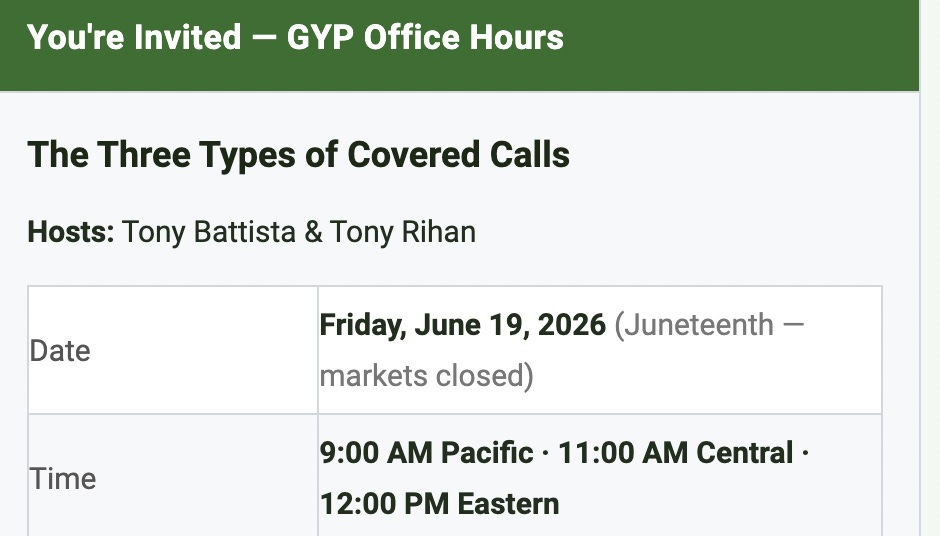
This week’s Office Hours is all about the covered call — but not just the textbook version. Tony Battista and Tony Rihan are walking through the three different ways to run one, why they exist, and how to choose the right one for your account and your view.
If you’ve been following our QQQ position and the weekly rolls — this is the session that explains the machinery under the hood.
The three we’ll break down:
The Traditional Covered Call — own 100 shares, sell a call against them. The classic income trade: how it works, what you give up, and why it ties up so much capital.
The Poor Man’s Covered Call (PMCC) — swap the 100 shares for a deep-in-the-money LEAP call as your “stock,” then sell the short call against that. Far less capital, defined risk, and the leverage math that makes it attractive.
The Long Synthetic Covered Call — build your “stock” synthetically (long call + short put), then sell the call against it. The most capital-efficient of the three — and the one that behaves the most like owning shares, including the downside.
We’ll cover when each one makes sense, the capital and risk trade-offs, how the weekly rolls work, and the traps in each version.
🔒 Members-Only Below — Join Details & Live Link
You’re Invited — GYP Office Hours
