


Box Trades
Almost everything we teach has an opinion baked into it. You’re long, you’re short, or you think the thing sits still for the next month. The box has no opinion at all, and that’s exactly why it’s worth an hour of your Thursday.
Start by forgetting options exist
Suppose Tony Battista promises to hand you $100,000 one year from today. What’s that promise worth right now?
Less than $100,000. Obviously. You’re giving up the use of your money for a year, and that gap is interest rates doing their job. Nothing controversial so far.
Now the interesting part. We’re going to manufacture that exact same promise out of four SPX options.
The four legs
A box is a bull call spread and a bear put spread sharing the same two strikes and the same expiration. Say SPX is trading around 6,500 and we use the 6,000 and the 7,000.
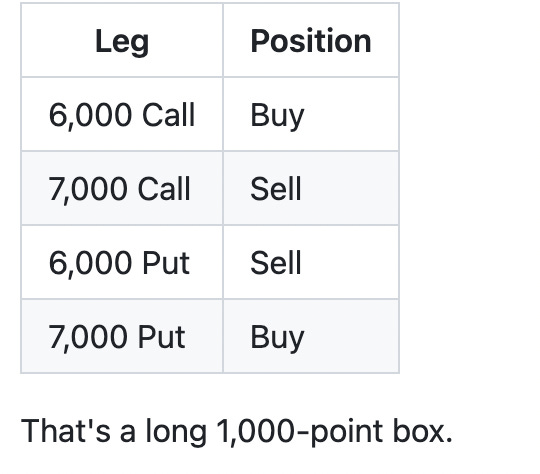
Now watch what the market can’t do to it
It doesn’t matter where SPX finishes. The box is worth the distance between the strikes, every time.
Finish at 6,500 and the call spread is worth 500 and the put spread is worth 500. Add them and you get 1,000.
Finish at 6,900 and the call spread is worth 900, the put spread 100. Still 1,000.
Finish at 6,100 and it flips the other way. 100 and 900. Still 1,000.
Up, down, nowhere. The answer is always 1,000 points, and 1,000 points times SPX’s $100 multiplier is $100,000. The payoff was fixed before you ever put the trade on.
So it isn’t a market trade. It’s a loan.
Here’s where it gets genuinely useful.
If the structure settles at $100,000 a year from now, nobody should pay $100,000 for it today. Maybe it trades around $96,000. You pay $96,000 now, you collect $100,000 at expiration, and that $4,000 is the financing return sitting inside the options chain.
That’s all a box price is. The options market answering one question: what is $100,000 payable at expiration worth today? Which is why box prices track interest rates and time to expiration rather than anything the S&P does.
Buy the box and you’ve lent money. Pay $96,000, receive $100,000 later.
Sell the box and you’ve borrowed it. Reverse all four legs. Sell the lower-strike call, buy the higher-strike call, buy the lower-strike put, sell the higher-strike put. Now you take in the cash today and owe the fixed value at expiration. This is why sophisticated traders will put a short SPX box up against other sources of financing and see which one is cheaper.
Why SPX specifically
This isn’t incidental. SPX options are European-style and cash-settled.
European exercise means they can’t ordinarily be exercised early, and early exercise is precisely what wrecks the clean financing economics of a box built from American-style equity or ETF options. Cash settlement means you don’t wake up owning or short a few thousand shares because one leg got assigned overnight.
Build the same structure on the wrong product and you’ve built a different trade.
The bit that makes it click
Remember put-call parity. A long call plus a short put is a synthetic long.
At the lower strike you’re synthetically long SPX. At the higher strike the opposite combination makes you synthetically short. Put the two together and the market exposure cancels out completely.
What’s left over is a fixed future cash payment. That’s the whole trade.
Where people get hurt
The word “guaranteed” does an enormous amount of work in most explanations of this structure, and it deserves some scrutiny.
The payoff may be mathematically fixed at expiration. That is not the same as the trade having no risks or no costs. Four legs means four bid/ask spreads. Commissions and fees are real. Settlement mechanics are real. Liquidity is real. Your broker’s margin treatment has opinions of its own, and closing early produces different economics than holding through settlement.
And one more, which matters more than any of the others: don’t trade a box off the displayed mid-price. A pricing difference that looks like rounding stops looking like rounding once you multiply it by $100 and a stack of contracts.
Thursday
We’ll build it from the ground up, live, and then take your questions. If you’ve ever pulled up a box, worked out that it pays the width, and closed the chain because you couldn’t see the point, that’s the question we want. Bring it.
Not a member yet? This is the kind of session members join for. Come learn to trade like the pros. growyourpile.com
Paid subscribers — the time and the link are below
Members, here’s your invite
📅 Thursday, September 17, 2026
5:00 PM ET · 4:00 PM CT · 2:00 PM PT
