


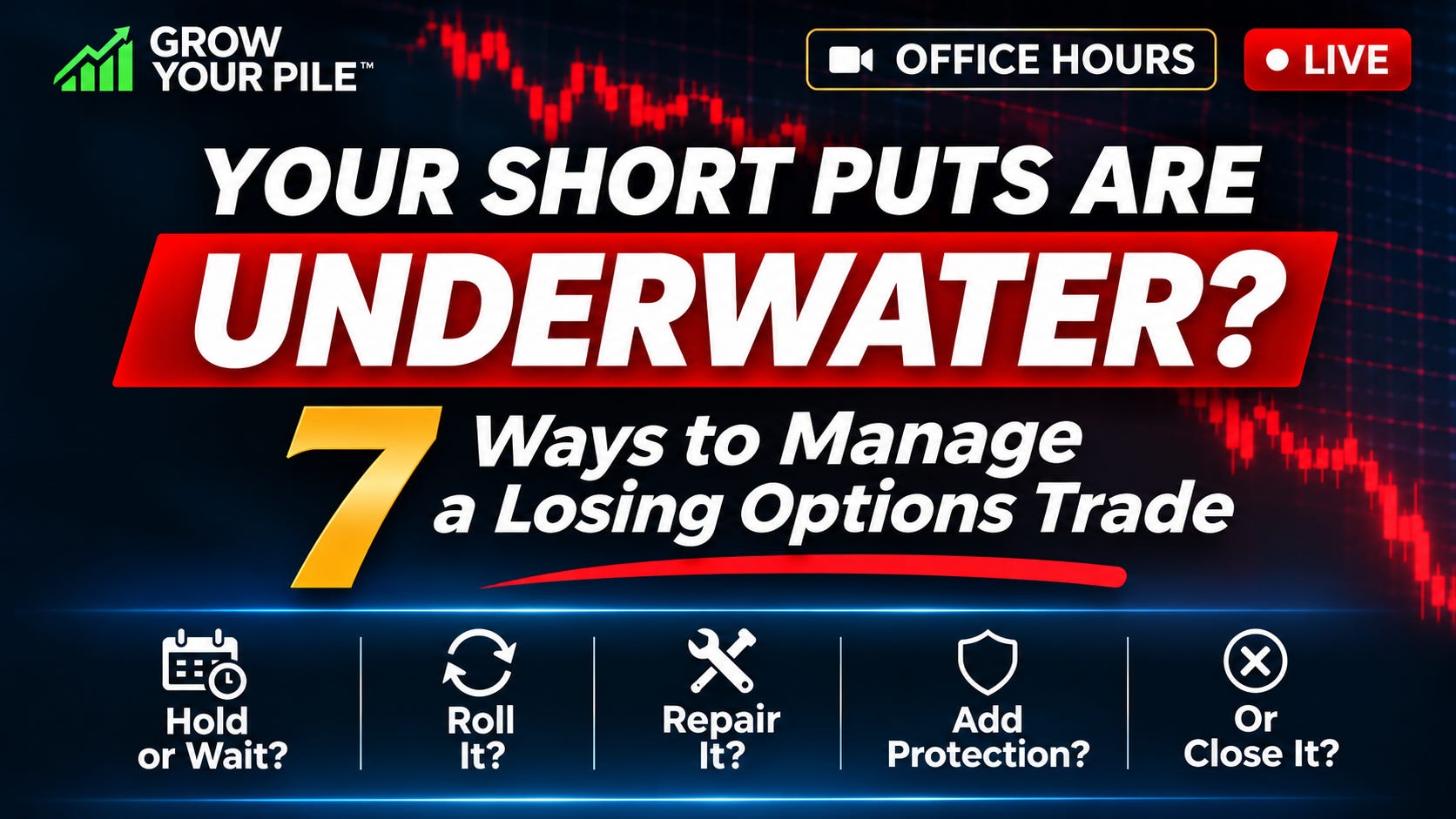
The market drops. Your short puts go deep in-the-money. Your losses grow. Your delta explodes.
Now comes the question that separates experienced options traders from everyone else: WHAT DO YOU DO NEXT?
Hello GYP Members and Friends,
Selling puts can be one of the most consistent strategies in options trading—until the market decides to remind us that there is no such thing as a free lunch.
We’ve recently experienced exactly that.
The Nasdaq has been under pressure, volatility has expanded, and several of our own short put positions have moved significantly in-the-money.
And with election uncertainty adding another potential catalyst, this is precisely when understanding how to manage a losing position becomes critical.
That’s why our next Grow Your Pile Office Hours is dedicated to one of the most important skills an options trader can develop:
HOW TO MANAGE A LOSING OPTIONS TRADE
With Tony Rihan & Tony Battista
We’re going beyond textbook explanations.
We’ll discuss the actual decisions we’re making in our portfolios, why we’re making them, and the trade-offs involved.
7 Critical Decisions Every Options Trader Must Understand
1. Roll Down, Roll Out, or Do Nothing?
When your short put goes underwater, which adjustment actually improves your position? And when does rolling simply postpone the problem?
2. When Your Short Put Starts Behaving Like Long Stock
Why deep ITM puts can become almost entirely directional—and why managing delta becomes more important than collecting theta.
3. Credit or Debit: What Really Matters?
Is rolling for a credit always better? Why paying a debit to reduce delta can sometimes be the smarter defensive decision.
4. Buying Time vs. Buying Protection
How extending duration changes your gamma, theta, and directional exposure—and why more time doesn’t automatically mean less risk.
5. When Should You Add More Risk to a Losing Position?
The difference between intelligently building a position and simply doubling down on a bad trade.
6. The Portfolio Matters More Than Any Individual Trade
How to evaluate buying power, total delta, correlated positions, and the risk of having multiple short puts challenged simultaneously.
7. When Is It Time to Take the Loss and Move On?
Perhaps the hardest decision of all. How do you recognize when a trade is no longer worth defending?
Real Trades. Real Adjustments. Real Risk.
Tony Battista will share how he’s been managing our challenged QQQ short puts, including rolling positions, reducing delta, and adjusting theta exposure.
Tony Rihan will discuss his approach to adding risk selectively, using smaller positions, and managing bullish exposure through volatile markets.
We’ll also explain why sometimes the best adjustment is to wait—and why trying to be a hero during a sharp selloff can be an expensive mistake.
This isn’t about predicting whether the market goes up or down tomorrow.
It’s about having a process that helps you make better decisions when the market moves against you.
Why You Don’t Want to Miss This Session
Most traders spend countless hours learning how to ENTER trades.
Very few spend enough time learning how to MANAGE them when things go wrong.
But that’s where some of the most important trading decisions are made.
The goal isn’t to win every trade. The goal is to manage your losses, protect your capital, and stay in the game long enough to Grow Your Pile.
We hope to see you at Office Hours!
Tony Rihan & Tony Battista
Grow Your Pile
🔒 PAID SUBSCRIBERS ONLY — OFFICE HOURS ACCESS
The session access information below is reserved for GYP paying members.
GYP OFFICE HOURS: HOW TO MANAGE A LOSING OPTIONS TRADE
Date: Thursday November 4th
Time: 2pm Pacific Time, 4mm Central - 5pm Eastern Time
JOIN THE SESSION HERE:
