Market Intelligence - Friday, August 14, 2026
Consumer sentiment collapsed, energy led, and Portfolio 1 finished the week at 3.40% buying power — the lowest of the year.
The story of the day
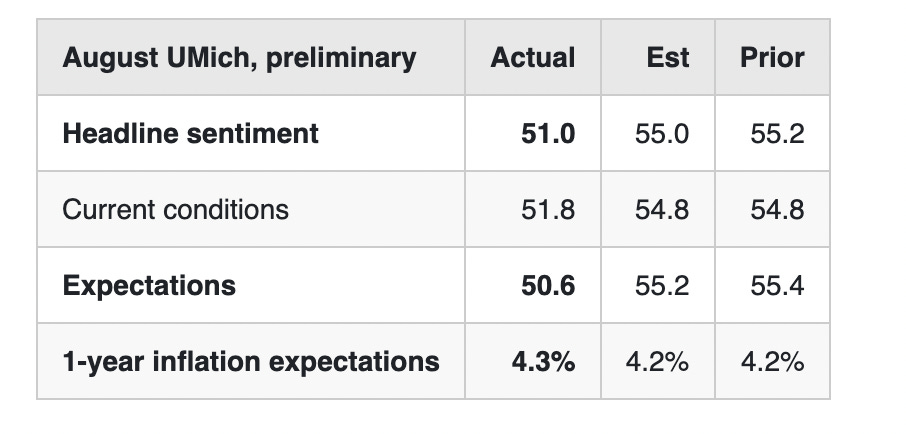
A four-point miss on the headline and a near five-point collapse in expectations, from 55.4 to 50.6 in a month. And inflation expectations went the wrong way at the same time.
Falling sentiment with rising inflation expectations is the stagflationary combination, and it lands two days after a CPI print that read cool. Two days ago the Fed was being priced softer. Today the consumer disagreed.
The energy data underneath it
Charlie Bilello published three things today that fit together. The Strategic Petroleum Reserve is at its lowest level since January 1983 — down 322 million barrels in five years, a 52% decline. Gas has reached $4.07 a gallon, the highest ever for this point in August. And US inflation has run above the Fed’s target for 65 consecutive months, averaging 4% a year since 2019.
That is why energy led the sector table at +1.5% today, and why a 4.3% one-year inflation expectation is coming from households who buy gasoline every week. Half the buffer that absorbed two decades of price shocks is gone.
The tape
Eight sectors up, three down — and the three down are technology, health care and financials. Small caps up, the Nasdaq down, money into energy and materials on a day the index went nowhere. That’s a rotation, not a rally, and it’s the third distinct internal pattern in three sessions.
Semis split in half
Sandisk +5.7%. Broadcom −5.0%, the biggest loser in the S&P 500. Both semiconductors, opposite directions, same session.
Korea rose another 1.7% for a fourth straight session, roughly 11.6% in four days. Google’s “severe memory crunch” price rise on Wednesday, Sandisk guiding the flash market up two thirds on Thursday, and now a five-point split between memory and the rest of semis. This is a shortage in one component repricing the companies that make it.
Volatility — our own data
The two-week bucket inverted overnight, and it’s the cleanest signal in our scanner this week:
The one-week point got cheaper on both. The two-week point jumped 15% on SPY and 10% on QQQ in a single session. For three days the two-week reading sat below the one-week; today it’s clearly above.
The market is pricing more risk two weeks out than one week out, and it happened overnight rather than gradually. August expiration is the 21st.
Trusted Voices
Liz Ann Sonders (Schwab) carried the UMich collapse in full, including the detail that matters: expectations fell nearly five points while one-year inflation expectations rose.
Charlie Bilello (Creative Planning) on the SPR at a 1983 low, gas at a record-for-the-date $4.07, and 65 consecutive months of above-target inflation.
Keith McCullough (Hedgeye) published “2-Year Treasury Yield: Lost Bullish Signal Strength” as his chart of the day. But the line worth keeping is this one:
“Just took a −0.07% loss because I don’t care about my cost basis. The market doesn’t care about you or your personal cost-basis problems.”
That’s the discipline behind half of today’s trades, and we’ll come back to it below.
Bottom line
A market at highs with a consumer at 51.0, energy leading on a depleted reserve, and volatility being repriced two weeks out. Portfolio 1 took money off. Portfolio 2 sold another put. Both are defensible and they’re pointing in opposite directions, which is worth watching rather than resolving.
Disclaimer
Grow Your Pile is educational. Nothing in this alert is investment advice or a recommendation to buy or sell any security. Options involve risk and are not suitable for all investors. Selling puts obligates you to purchase 100 shares per contract at the strike price regardless of how far the underlying has fallen; the maximum loss is the strike price times 100 per contract less the credit received, and can far exceed the premium collected. Short-dated options carry assignment risk that can materialise over a weekend on a single adverse move. Long options can and frequently do expire worthless, losing the entire premium paid. Futures involve leverage and can produce losses exceeding your initial margin. Volatility products carry additional structural risks including contango decay, and are not suitable for buy-and-hold exposure. Assignment can occur at any time on American-style options, including before expiration. Past performance is not indicative of future results, and results shown are those of our own accounts and are not representative of any member’s results. Read the Characteristics and Risks of Standardized Options before trading.
Tony Rihan & Tony Battista growyourpile.com


