Market Intelligence Report
We ran the same trade twice and ended up with two butterflies that can't lose
The panic we sold into on Tuesday unwound in a single session.
Two days ago we wrote about a memory complex being taken apart — Sandisk down 55% on the month, Marvell 43%, Intel 40%. Today:
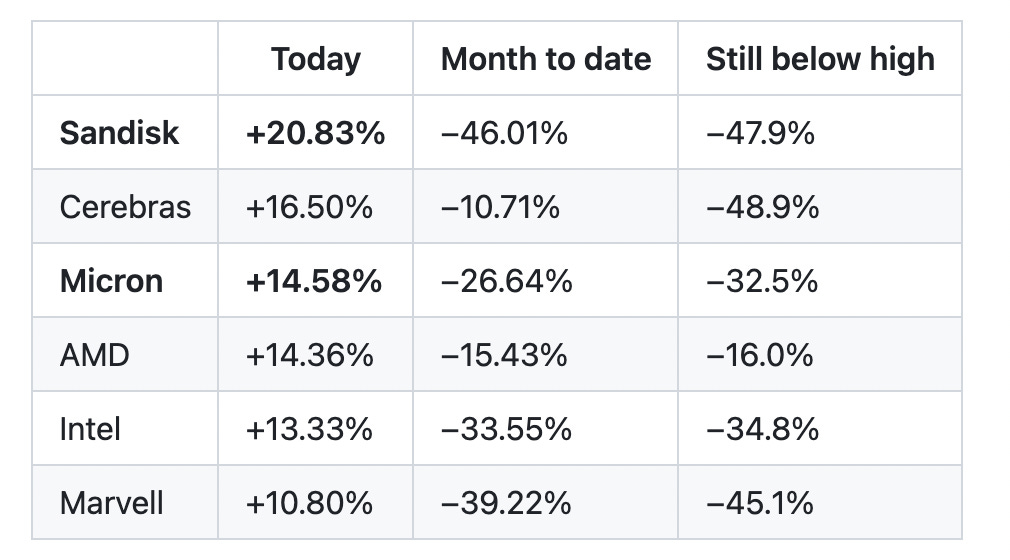
Look at those two columns together. Every one of these names put on double digits today and every one is still deeply underwater for the month. That’s what a violent reversal inside a downtrend looks like, and it’s the reason we size starter positions rather than full ones — because a name that can fall 46% in a month can rise 21% in a day, and nobody times either end of that.
And there is now a name attached to both halves of that move. CNBC reports that star AI investor Leopold Aschenbrenner is unwinding trades after steep losses, and that his fund, Situational Awareness, has exited all of its public equity positions. ZeroHedge is calling it “Archegos 2.0.”
We can’t see the fund’s book and won’t pretend to. But a large, levered, AI-concentrated portfolio being liquidated through July would explain a memory complex falling 30–50% with no change in fundamentals, and the selling stopping the moment the liquidation finishes would explain today. If that’s what happened, the memory panic was substantially a plumbing event rather than a verdict on the industry.
We sold puts into that panic on Tuesday. If this reading is right, we were paid a fear premium created by somebody else’s margin call — which is close to the best reason to sell premium there is. It also means we should be slower to treat the derating as information. Forced selling and informed selling look identical on a chart and mean opposite things.
The tape. Nasdaq 100 28,011.09, +3.0%. S&P 500 7,412.07, +1.3%. Dow +0.7%. Russell +0.4%. VIX 18.39, down 11.0%.
The earnings split is the whole story of the day. Microsoft +14.35% — the capex question everyone was arguing about got an answer the market liked. Meta −9.38% — it did not. That single divergence is why Technology was the best sector at +5.0% while Communications was the worst at −3.3%, on the same afternoon. Health Care and Staples were both −2.3%: money didn’t arrive from outside, it rotated out of defense and into the thing that just reported well.
Risk appetite showed up nearly everywhere. South Korea +8.2% — the worst market on the board for three straight sessions is now the best, which fits the forced-selling story above. Japan +3.7%, emerging markets +3.2%, developed +2.4%. Convertibles +2.6%.
But do not read the yen as risk appetite. USDJPY fell 3.3% to 158.07, and the reason appears to be the Bank of Japan rather than the market — ZeroHedge’s read was blunt: “BOJ finally woke up: USDJPY plunging, looks interventiony.” A central bank defending its currency is not the same signal as investors buying it, and conflating the two is how people misjudge these days.
This morning’s data, and why the rally is defensible but not clean
Three prints landed before the open. They don’t all say the same thing.
Growth missed and inflation cooled at the margin. Core PCE rose only 0.1% on the month against 0.2% expected, which is the number that gave equities permission to rally. Kevin Hassett said outright that “Warsh’s job just got a bit easier with today’s inflation data.”
But read the level, not just the change. Core PCE is still 3.3% year over year and headline 3.7%, against a 2% target and a funds rate of 3.50–3.75%. The real policy rate is barely positive. One cooler month doesn’t make that comfortable, and GDP at 1.5% with inflation at 3.3% is a soft-growth, sticky-price mix — not the disinflationary boom the tape traded like today.
Claims at 197,000 say the labour market is still tight, which is the part of this that genuinely supports the Fed holding rather than cutting.
The bond market isn’t celebrating. Ed Yardeni’s verdict via CNBC: Chairman Warsh “fails first test as Bond Vigilantes drive yields higher.” Equities up 1.3% while long yields rise on a soft GDP print is a divergence, not a confirmation.
And the Gulf is still constricted. Kpler reports vessel clearances near recent lows and Gulf loading activity down by more than half, despite a four-day pause in US strikes. Iran’s Revolutionary Guards have now claimed responsibility for the attack on the Ali Al Salem airbase in Kuwait, and Saudi Arabia says it will strike back in self-defence. Crude fell anyway, to $84.21. When the news flow and the price disagree this plainly, one of them is wrong — and not knowing which is exactly the argument for structures whose downside is already known.
What didn’t play along: Brent slipped to $90.07 (−0.7%) and crude to $84.21, so the war premium is still leaking out. Gold went the other way, extending to $4,103.67, up 1%. Real estate −1.6%, energy −0.8%.
The people we read — and the number that explains today
Charlie Bilello put his finger on exactly why Microsoft and Meta went opposite directions, and it isn’t that one spent on AI and the other didn’t. They both did.
Meta reported free cash flow of $784 million in Q2, down 91% from a year ago and the lowest since Q3 2022 — driven by massive capital expenditures on AI infrastructure.
Set that beside Microsoft, where Bilello’s revenue series shows 2026 estimated at $360 billion against $305 billion last year. Microsoft is spending enormously too, and the market gave it +15.1% — its biggest one-day percentage gain since 2008.
So the market isn’t punishing AI spending. It’s punishing AI spending that hasn’t shown up in the numbers yet. Alphabet reported record revenue with its first negative free cash flow since the 2004 IPO and fell 7%. Meta’s free cash flow fell 91% and it dropped 9.4%. Microsoft’s revenue is up $55 billion year over year and it rose 14%. Three companies, one question, and the market answered it the same way each time.
Bilello also has the fiscal picture, which hasn’t gone anywhere just because equities had a good day: “The US National Debt has increased by over $400 billion since July 1st… Next stop: $40 trillion.” Read that next to the bond vigilantes driving yields higher, above — they are the same story told from two ends.
And here is what actually matters for us
Our own scanner shows the event premium being let out:
Yesterday the market priced a genuinely uncertain afternoon. Today it prices an ordinary Thursday — with Apple and Amazon still to report tonight, and Apple already down 1.85% into the print.
Said plainly: we sold into rich volatility and that volatility has now collapsed. VIX down 11%, expected moves down a third to a half. That is good for the marks on everything we are short, and you can see it in the Greeks below, where our extrinsic fell $2,455 in a day while the account gained $5,048. It is considerably less generous for anything we would want to sell today. Being paid well to take a risk and being paid poorly to take the same risk look identical on the order ticket. The difference only shows up later.
Grow Your Pile is educational. Nothing here is a recommendation to buy or sell any security. We show you our trades and our reasoning so you can learn the framework. Your account, your size, your risk. Options involve risk and are not suitable for all investors. Selling puts carries undefined downside risk, and a butterfly that cannot lose at expiration can still mark against you before it. Past performance is not indicative of future results, and the results shown are those of our own accounts and are not representative of any subscriber’s results. Read the Characteristics and Risks of Standardized Options before trading.
Tony Rihan & Tony Battista Grow Your Pile


