


Monday, August 17, 2026
Grow Your Pile is educational and is not investment advice or a recommendation to buy or sell any security. Options involve risk and are not suitable for every investor.
The one-line read
The tape barely moved, volatility jumped five percent, and the money that left American stocks today went to Korea, China and gold rather than to cash or bonds. That is a rotation, not a retreat.
The story of the day
Here is the board at midday.
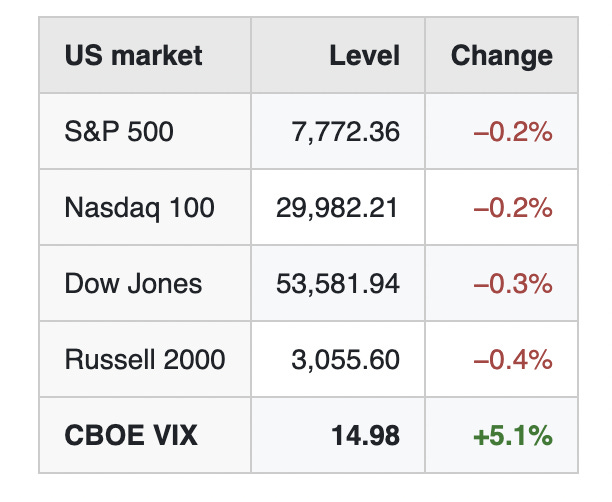
A volatility move five times the size of the price move, running in the opposite direction. That is not a market reacting to a decline, because there hasn’t been one. It is a market paying up for protection while the tape sits still.
Now look at where the money went instead.
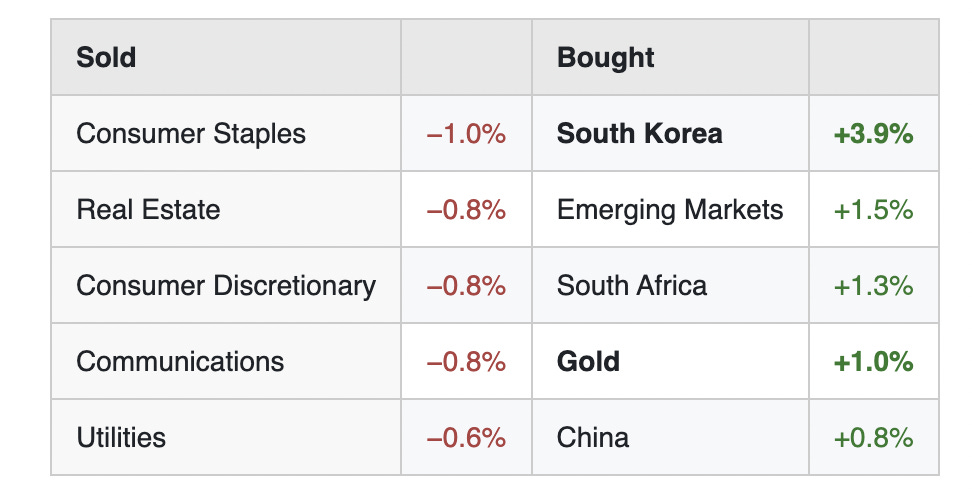
The detail that settles it is that consumer staples was the worst sector on the board. A genuine flight to safety buys staples and buys duration. Today staples finished last, real estate and discretionary were equally weak, long Treasuries were down, and every credit line we track finished within a tenth of a percent of unchanged.
Defensives were not bid. This was money leaving American equities for foreign ones and for gold, with a little insurance bought on the way out. It is a very different thing from investors getting scared, and it has different consequences.
What our own data said before the open
We run a scanner across four underlyings every morning that prices the expected move at each tenor. To compare a one-week reading against a two-week one you have to strip out time, because a longer option always implies a bigger move. Divide the expected move by the square root of the days and you get the price of risk per unit of time, which is comparable across the curve.
On Friday that measure showed something odd: the two-week point was bid above the one-week on both SPY and QQQ. The obvious explanation was an expiration-calendar quirk that would wash out over a weekend.
It didn’t. It widened.
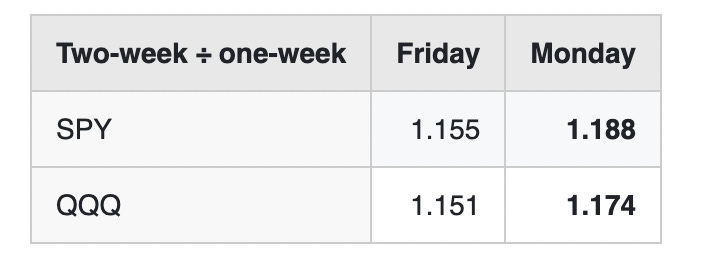
Anything above 1.0 means two weeks out is priced richer per day than one week out. Both readings rose across the weekend. Roughly three hours later the VIX was up 5.1% on a tape that had gone nowhere.
Two weeks out from this morning is the last week of August. August expiration is Friday the 21st.
There is a second thing in that data worth knowing. SPY’s one-week point is now the cheapest spot on its entire curve — cheaper than the overnight, cheaper than everything longer.
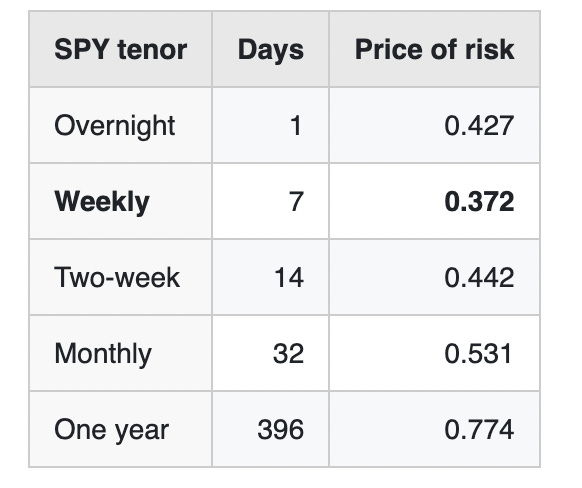
It is worth being careful about what that means, because it is easy to read backwards. Cheap weekly volatility does not mean a one-week strike is safer. It means selling one-week premium pays you less than it did. When the front week is the cheapest thing on the curve, it is the worst-compensated place to be short, not the best.
Gold moved after the options did
At half past nine gold was flat and its price of risk had turned up for the first time in four sessions — the one-week reading rose 2.2%, the two-week 4.2%, with GLD unchanged at $402.56.
By late morning spot gold was $4,418.73, up 1.0%.
The options market paid up for gold risk before gold moved. That is not a prediction and we would not build a position on it alone, but it is the clearest example this month of the volatility surface leading the price rather than following it.
Gold now sits under a genuine technical ceiling. Its 200-day average is $412.35 and the upper Bollinger band is $409.33 — two different measures, three dollars apart, forming a shelf about 0.7% wide that it has to clear in one move.
Meanwhile Wells Fargo cut its year-end gold target to $4,900–$5,100 from $5,300–$5,500, and its 2027 target to $5,400–$5,600. Still substantially higher than here, but the direction of the revision is down.
Crude still isn’t moving, and that remains the point
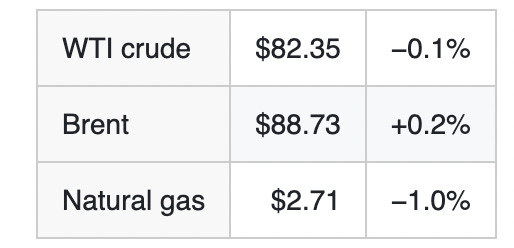
WTI closed Friday at $82.34. It is $82.35 now. The Strait of Hormuz is effectively closed to commercial shipping and the crude price has not moved a cent in three sessions.
We wrote at the weekend about why: Saudi Arabia’s East-West pipeline to the Red Sea and the UAE’s Habshan-Fujairah line together carry more capacity than the shortfall, so the barrels are getting out by another route. What those pipelines cannot move is refined product, which is why diesel crack spreads hit an all-time high last week while crude sat still.
Nothing today changes that. The IRGC denied the existence of backchannel talks, and Yemen warned of a reciprocal response to any Saudi escalation. The crude price continues to ignore all of it.
The data underneath: a beat that wasn’t one
August’s Empire Manufacturing index, via Liz Ann Sonders, doubled expectations.
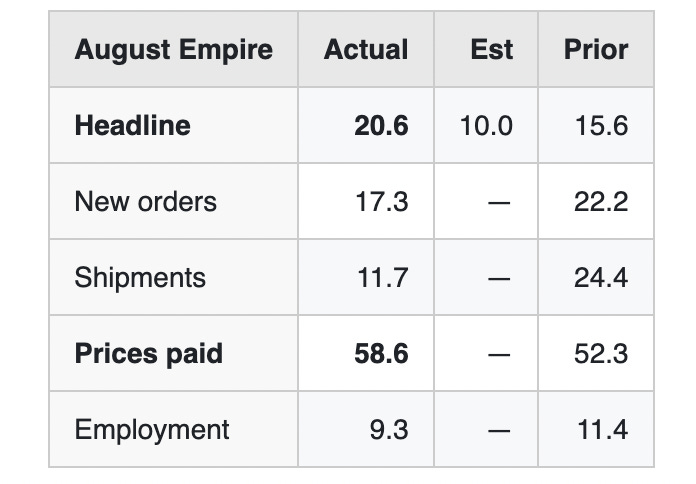
Read past the headline and every sub-index went the wrong way except one. Shipments more than halved. New orders fell. Employment fell. The only component that rose was the price manufacturers are paying for their inputs, up six points.
Activity survey up, forward demand down, costs accelerating. That is the third release in two weeks where the headline and the internals told opposite stories, after a consumer sentiment print of 51.0 against 55.0 expected with inflation expectations rising at the same time.
Peter Mallouk, reposted by Charlie Bilello, put it more bluntly: two percent inflation is not what is really happening.
The AI story is quietly becoming an AI debt story
Four separate items landed today that are all the same item.
Charlie Bilello published the number that matters: nine major technology companies carry roughly $3 trillion in off-balance-sheet commitments, against reported capital spending of about $600 billion. Reported capex is a fifth of the actual obligation. Five times more has been committed than shows up in the place investors look.
Alongside that, the ECB warned that equity valuations may be heading for a correction as AI enthusiasm pushes technology toward dot-com-era levels, noting that unlike in 2000, policymakers have far less room to cut rates or spend their way through it.
Nvidia is reported to be investing $100 billion in an OpenAI data centre in Ohio. And Doug Kass flagged Google going to Australia to issue Kangaroo bonds to fund AI spending. Last week AMD announced a $5 billion four-part bond sale, its largest ever, for the same purpose.
None of this says the AI trade is wrong. Technology was the second-best sector today, green while the index was red. What it says is that the buildout has moved from being funded out of cash flow to being funded with debt and off-balance-sheet structures, at a scale the reported numbers do not capture, and that serious institutions have started saying so in public.
If you are looking for a candidate for what the options market is pricing two weeks out, that is a more plausible one than anything on the economic calendar.
Trusted Voices
Liz Ann Sonders (Schwab) carried the Empire print in full, including the detail that matters: headline 20.6 against 10.0 expected, with new orders, shipments and employment all falling while prices paid rose to 58.6.
Keith McCullough (Hedgeye) remains short long-duration Treasuries, with the line that 60/40 retirement accounts are being “sizzled by the duration part,” and his chart of the day showing 2s10s twenty-five basis points off the July low. The curve is steepening.
Danielle DiMartino Booth (QI Research) pointed for the second week running at housing and mortgage credit rather than equities, amplifying Melody Wright’s work on warnings emerging from the latest mortgage meltdown as July sales disappointed.
Charlie Bilello (Creative Planning) on the $3 trillion of off-balance-sheet AI commitments, and on inflation not being what the headline number says.
Doug Kass (Seabreeze Partners) on Google funding its AI spending with Kangaroo bonds in Australia.
What’s ahead
This is retail earnings week, arriving directly on top of the weakest consumer sentiment print in a long time.
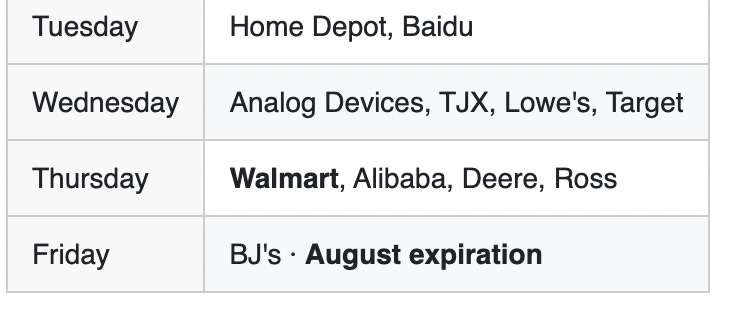
Walmart, Home Depot, Lowe’s and Target all report in a week where the health of the consumer is the open question. And Friday is both August expiration and the date the volatility curve has been pointing at since last week.
Also worth noting: France’s thirty-year yield is back at an eighteen-year high of 4.86%, and Meta goes to federal court this week in a social media addiction trial where the company itself has put potential damages at $1.4 trillion.
