Market Intelligence - Thursday, August 13, 2026
The Nasdaq broke 30,000, oil finally cracked, and the VIX is at 14.50 with the S&P a fifth of a percent from its 52-week high.
Market Intelligence
The one-line read
The Nasdaq broke 30,000, oil finally cracked, and the VIX is at 14.50 with the S&P a fifth of a percent from its 52-week high.
The tape
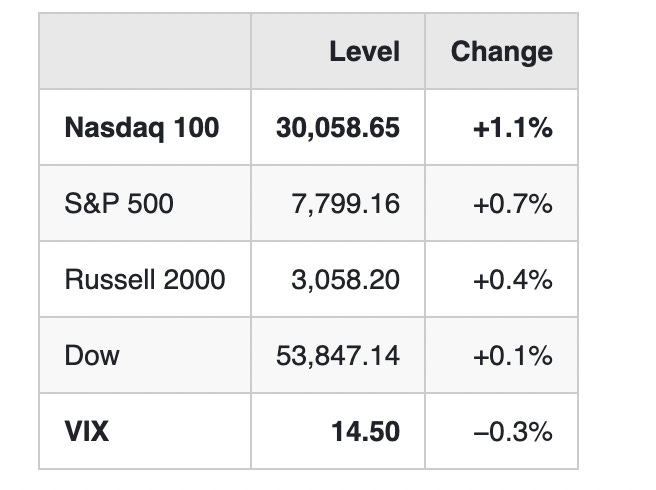
Levels are intraday as of late morning Eastern.
Eight sectors higher, three lower — technology +1.3%, communications +1.2%, real estate and staples both +1.1%. That’s the reverse of yesterday, when seven of eleven fell and the index rose anyway on technology’s weight alone. Two green closes, opposite internals. Today’s rally has participation behind it.
SPY sits 0.20% below its 52-week high and IWM 0.35% below its.
Rates, and the number underneath them
Treasuries +0.4%, TIPS +0.4%, high grade +0.6%, high yield +0.3%, convertibles +1.1%. The biggest move in the long-duration line all week.
Two things behind it. Prediction markets now put roughly a 70% chance the Fed holds in September against about 30% for a hike, with a cut barely priced at all. And Richmond Fed’s Barkin said the labour market “may not be as strong as indicated by data and should be viewed as vulnerable,” flagged the durability of consumer spending at lower incomes, and noted the Fed is not currently giving forward guidance.
Then Fitch reported that the US private credit default rate remains at a record high in July.
Set that against LQD +0.6% and HYG +0.3%. Danielle DiMartino Booth has spent this week pointing at exactly that gap — 68,900 job cuts in July, the first monthly rise since March, CMBS delinquencies up 51 basis points, HOA foreclosures up nearly 40% on two years ago. None of it appears in the credit ETFs, because private credit, commercial mortgages and homeowner liens don’t trade in them.
Index credit looks calm because the stressed parts of the system aren’t in the index. Yesterday that was an argument. Today Fitch put a number on it.
Oil finally broke
Crude −2.7% to $81.04. Brent −2.5% to $86.74.
Yesterday we wrote that oil had absorbed a 19-million-barrel inventory miss and held, and that the geopolitical premium looked more embedded than a single headline could shift. It broke a session later. The direction of that read was right and the timing was wrong, and we’d rather say so than quietly move on.
But the disruption itself hasn’t gone anywhere. UKMTO reported today that tanker transits through the Strait of Hormuz remain in single digits in both directions, commercial traffic is still reduced, and the IRGC continues to harass and surveil merchant shipping even without confirmed attacks in the latest period.
Single-digit transits is not a working waterway. What came out of the price this week was the fear premium, not the blockage.
Gold came off with it — spot −0.6% to $4,381, ending a four-day run.
The memory trade keeps compounding
Sandisk +6.2% · Marvell +5.1% · Intel +5.0% · Micron +5.0%, and South Korea up another 1.6% for a third straight session — roughly 10% in three days.
The catalyst came from inside the industry: Sandisk’s head of market intelligence said the flash memory market will grow to over $300 billion in 2026 and approach $500 billion in 2027. That is roughly two thirds of growth guided in a single year.
That’s the third day running this complex has produced a headline — Google raising Pixel prices $100 on a “severe memory crunch” on Wednesday, Korea’s two-day 8% run, now a supplier guiding the market up two thirds. We sold starter puts into this group during the July panic, when Sandisk was down 52% on the month.
Volatility — our own data
SPY rose 0.83%, to within a fifth of a percent of its 52-week high, and the market’s price of risk on it didn’t move at all — 0.397 per unit of time-risk at a week, against 0.396 yesterday.
Gold’s did move, and downward across every tenor — the one-week reading fell from 0.933 to 0.790, a 15% drop, with the whole curve lower. For three sessions gold’s curve sat pinned between 0.93 and 1.00 while the price climbed. Today the price fell and the pricing of risk came down with it.
Sentiment
CNN’s Fear & Greed read 63 — Greed yesterday, up from 60 at the prior close, 59 a week ago and 46, Neutral, a month ago. Rising steadily.
Greed climbing, the VIX at 14.50, and the cheapest expected moves we’ve recorded this month. That’s the context for today’s trade.
Trusted Voices
Liz Ann Sonders (Schwab) carried yesterday’s CPI print — +3.4% headline against +3.4% expected and +3.5% prior, core +2.5% from +2.6%. In line on both, cooler than the month before on both.
Danielle DiMartino Booth (QI Research) has spent the week pointing at where credit stress actually sits — 68,900 job cuts in July, the first monthly rise since March, CMBS delinquencies up 51 basis points, and HOA foreclosures up nearly 40% on two years ago. Today Fitch put a number alongside it: the US private credit default rate remains at a record high. None of that trades in HYG or LQD, which is why both finished green.
Charlie Bilello (Creative Planning) published the global 10-year table this week — the US at 4.71% nominal. On the 3.4% CPI print the measured real yield works out near 1.31%, middling against the UK’s 2.40% and Sweden’s 2.83%.
Catalysts — what’s on the calendar
Tomorrow, Friday Aug 14. Our QQQ 725 put expires. So do three SPY 754 puts in Portfolio 1, bought Tuesday for $75 as cover into the CPI print — with SPY at $779 they will expire worthless, the third short-dated tail leg to do so in eight days. That is what the insurance costs, and we book it as a loss every time.
Wednesday Aug 19. The Mini VIX covered call in Portfolio 1 settles. Long two Mini VIX futures at 16.84 against the Aug 19 16.5 and 17 calls sold for $174. Breakeven is 15.97 and the VIX is at 14.50, so the position is currently around −$294 and needs a 17% jump in volatility inside six days to reach its $156 maximum. It is going against us and we would rather say so while it is open than explain it after settlement.
Friday Sep 18. The big expiration — four short SPY 745 puts and all three SPX butterfly structures in this book.
Bottom line
A market at highs, participation broadening, the Fed being priced softer, and volatility at its cheapest in weeks. Every one of those is a reason premium sellers get paid less for the same risk. That is the environment we sold into today, and it’s why the commentary below is more cautious than the trade looks.
Disclaimer
Grow Your Pile is educational. Nothing in this alert is investment advice or a recommendation to buy or sell any security. Options involve risk and are not suitable for all investors. Selling puts obligates you to purchase 100 shares per contract at the strike price regardless of how far the underlying has fallen; the maximum loss is the strike price times 100 per contract less the credit received, and can far exceed the premium collected. Short-dated options carry assignment risk that can materialise overnight on a single adverse move. Assignment can occur at any time on American-style options, including before expiration. Past performance is not indicative of future results, and results shown are those of our own accounts and are not representative of any member’s results. Read the Characteristics and Risks of Standardized Options before trading.
Tony Battista & Tony Rihan growyourpile.com


