


September 30, 2026 · Portfolio 3 (ETF Macro)
Portfolio 3 is closed. Every line, down to cash, nothing left open. Tomorrow morning the account starts again at zero and we build it back in front of you.
Nothing broke. Nobody’s in trouble. This is a decision, and I want to give you the whole of it, including the part where the year didn’t go the way I drew it up.
The last 12 months
Portfolio 3 has been in front of you for about a year. That’s the anniversary I mean, and it’s worth being exact about it, because the book itself is older. I was running this portfolio before we launched Grow Your Pile. The oldest position still on the sheet went on the second of October last year, and the portfolio it sits inside goes back further than anything we’ve ever published about it. That’s also why the published record has holes in it, and I’ll come back to that.
Portfolio 3 returned 14.2% in the last 12 months. That comes off the portfolio’s own record and it takes in realized profits, interest and dividends along with what the positions themselves did.
What I can put in front of you line by line is the closing snapshot. On the day it came down the book was marked at $105,127.84 against the $100,000 stake the published version of this portfolio runs on, which is 5.13%. Don’t read that as a slice of the 14.2% with a remainder hiding behind it. It’s a different measurement, and the two don’t subtract.
The 5.13% is the one I can take apart line by line, so that’s what I’m going to do. This is the bit I’d read first if I were you.
Nine lines finished green, two red, and the twelfth was the cash line. Together they came to $6,054.41 of gain on the positions themselves, priced at the September 30 marks. Now look at where that came from.
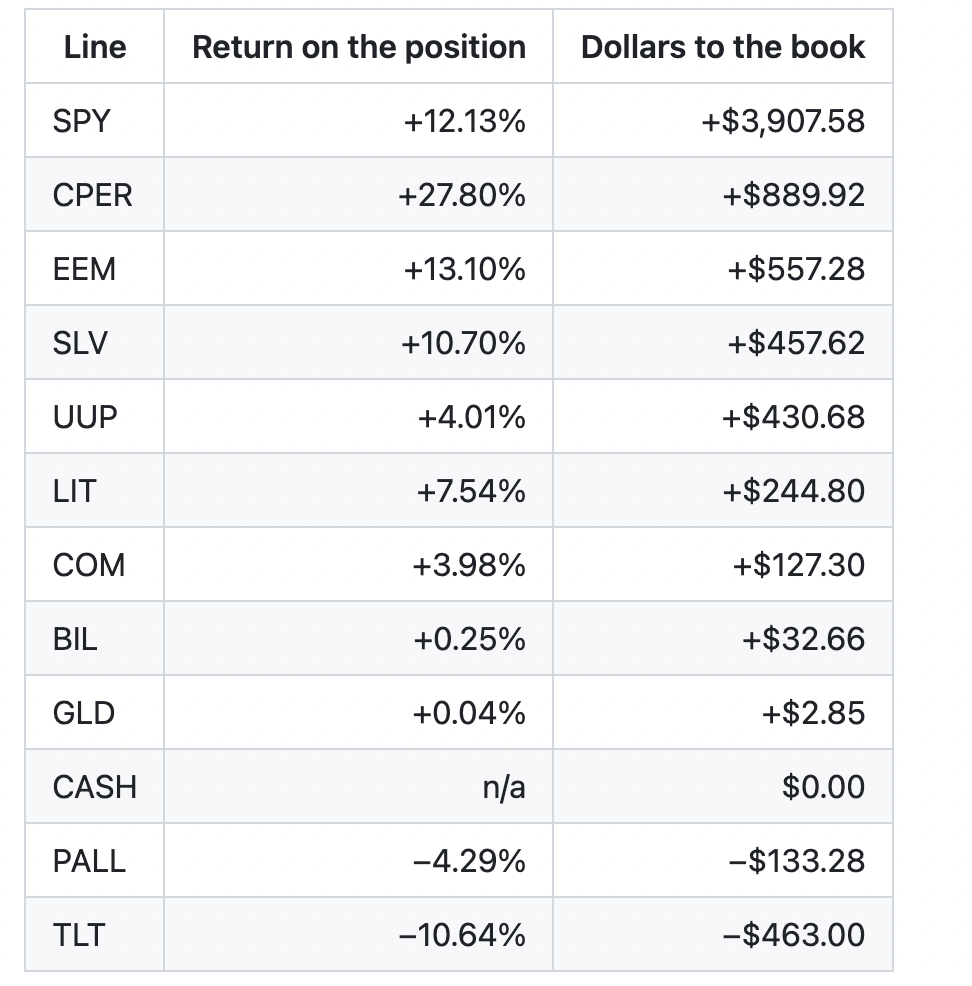
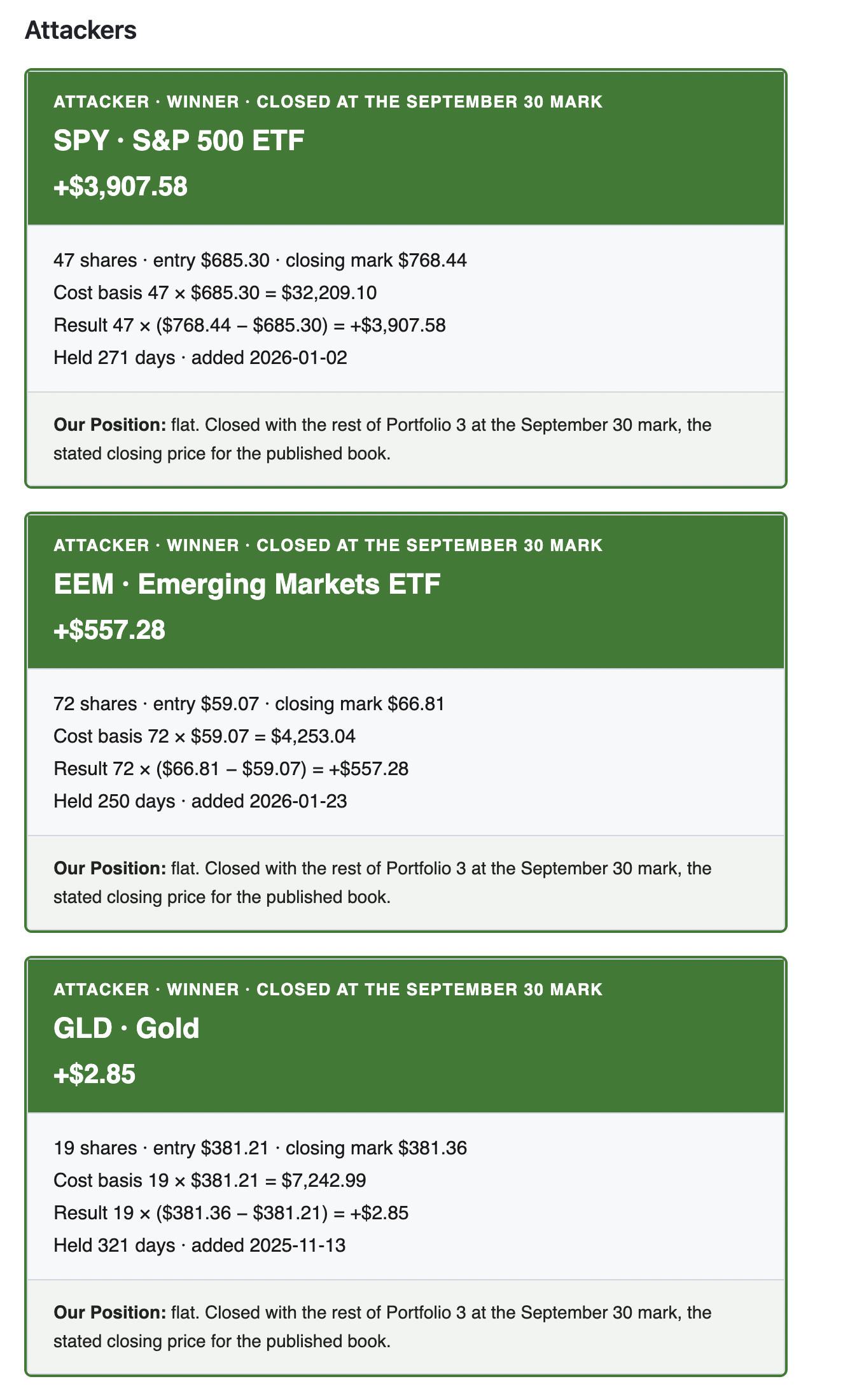
SPY by itself is $3,907.58 of that $6,054.41. Nearly two thirds of that gain came out of a single position, and it was the position carrying the largest weight. Take SPY out and the other eleven lines made $2,146.83 on $66,864.15 of cost, which is about 3.2%.
I’m not going to pretend that’s a portfolio working. That’s one line working and the rest along for the ride.
While you’re looking at that table, compare CPER and SPY, because it’s the most useful thing on it. CPER returned 27.80% and put $889.92 into the book. SPY returned 12.13% and put $3,907.58 in. The percentage tells you how good the idea was. The dollars tell you how much it mattered. Those are two different questions and only the second one pays for anything.
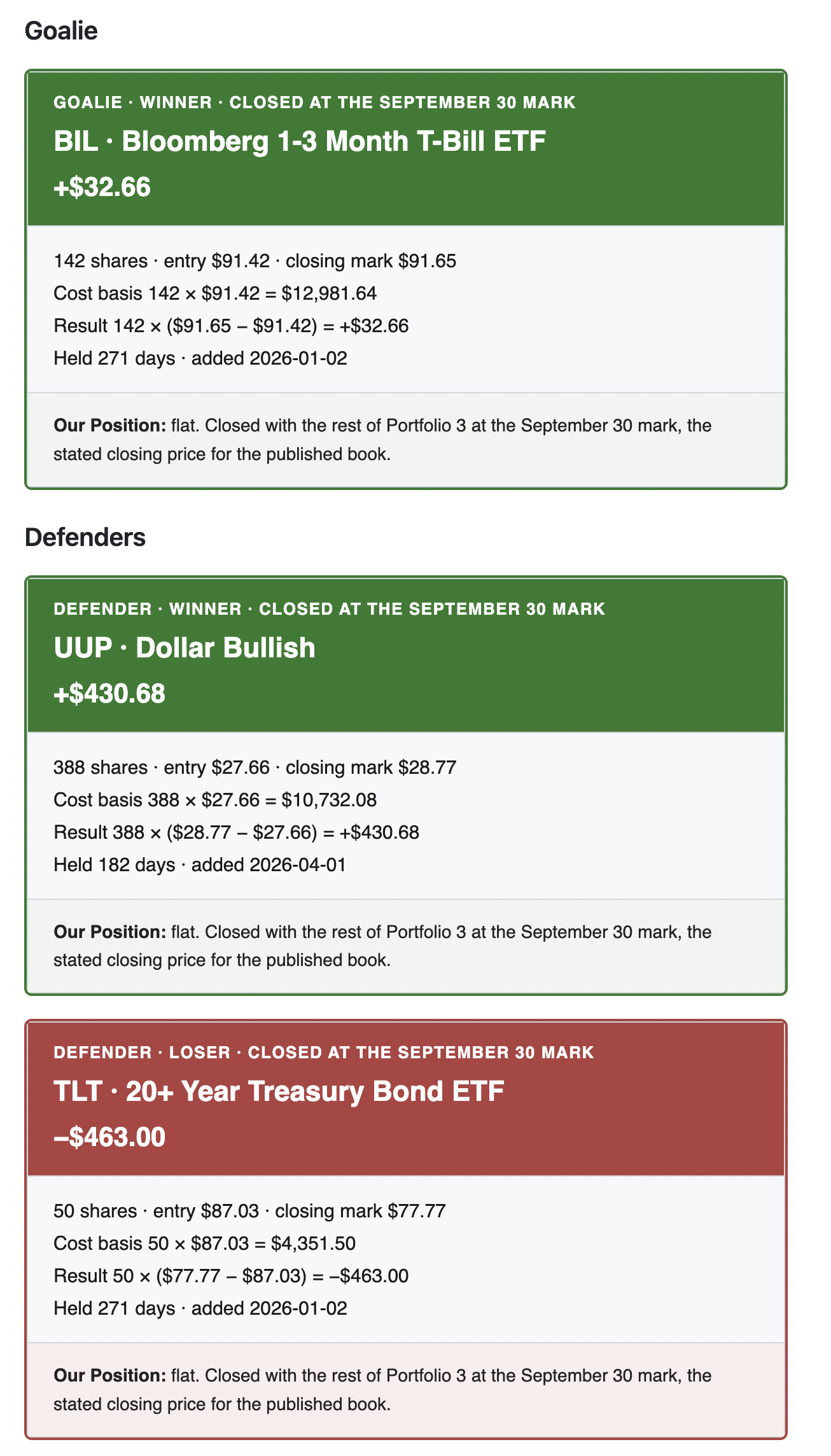
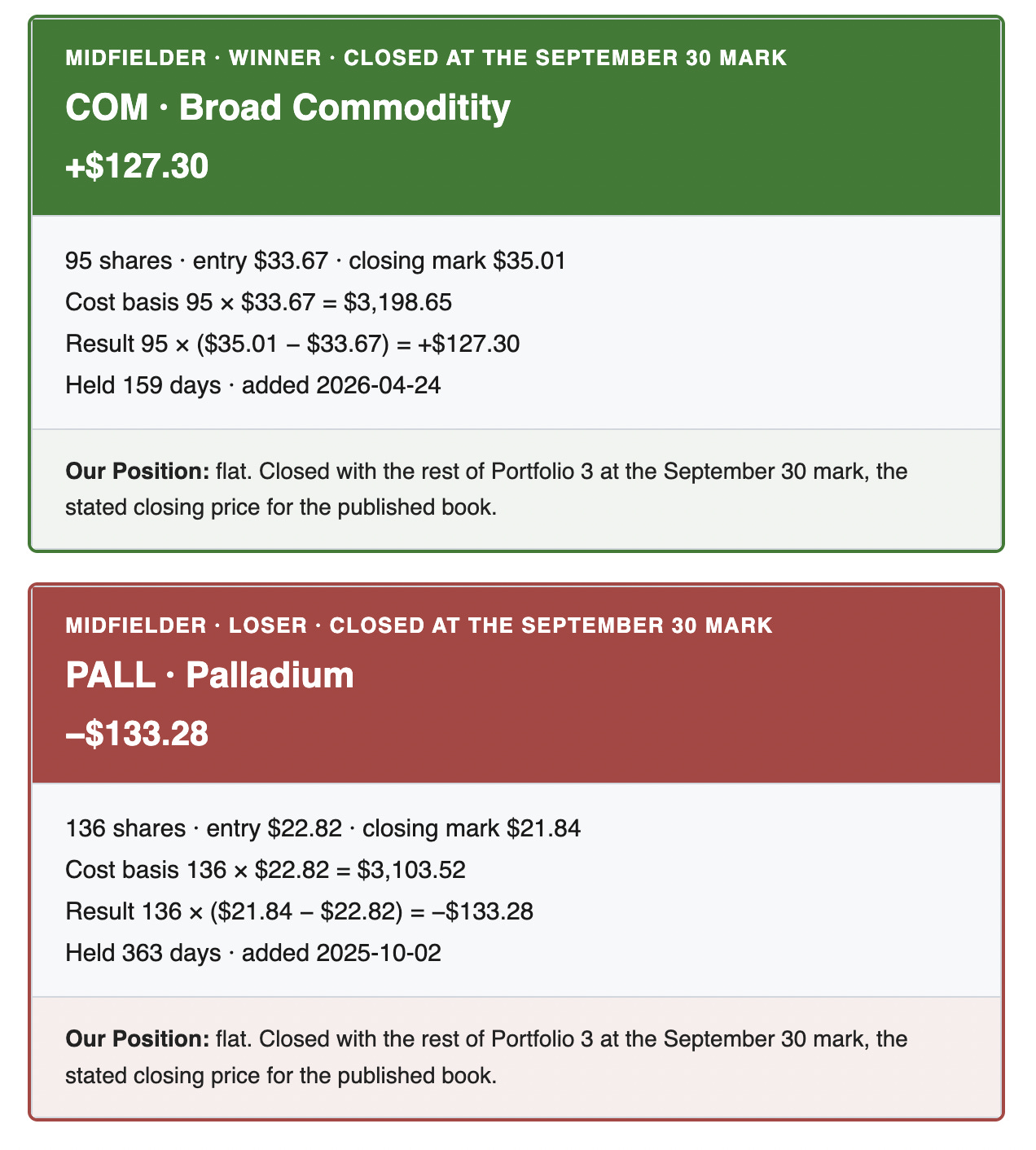
The reds, plainly. TLT is down 10.64% and has been in the book since January 2. PALL is down 4.29%, and it was the oldest position we owned, the one the whole year gets dated from. GLD is up four hundredths of one percent: ten and a half months of holding gold for two dollars and eighty-five cents, which is its own kind of answer.
One caveat on that table, and it matters. It only shows what survived. Five positions left the book during the stretch we’ve been publishing it, and only two of those exits are in the published record. The other three came off before the dashboard was tracking closes, and I can’t put an honest number on them, so I’m not going to put a dishonest one on them either. And because the portfolio is older than the record, what you can see of its history is not all of its history.
That’s also why those two numbers don’t line up, and I’d rather you know than wonder. The table adds to $6,054.41, which is what the twelve surviving positions did on price alone. The 5.13% is the whole book at $105,127.84 against its $100,000 stake. Those measure different things and neither one is wrong. The table is only the survivors. The 5.13% is everything, so whatever came back from the positions that left is already sitting inside it.
Now the part I care about more than the table. I’m not dressing up those two red lines, and I’m also not going to apologize for both of them, because one was doing precisely what I bought it for. That’s the whole point of running this book as a team. The goalie is not supposed to score. The defenders sit there looking useless right up until the week they aren’t. If every line in a macro portfolio is green at the same time, you don’t own a portfolio. You own one bet wearing eleven jerseys.
Which of those two red lines bothers me and which one doesn’t is exactly the distinction I’m making. A defender that costs you ten percent while equities were going up is doing close to its job. A midfielder that’s been in the book since the first week and is still down is a different conversation. Both of them are on the dashboard, sitting next to everything else, the way they’ve been all year.
What “to zero” means
It means what it says. No trims, no rolling anything into next month, no keeping the two or three names I happen to like. Eleven lines came out. The twelfth was the cash line, a bit under a tenth of the book, and there was nothing to do with that one. Cash, and then nothing.
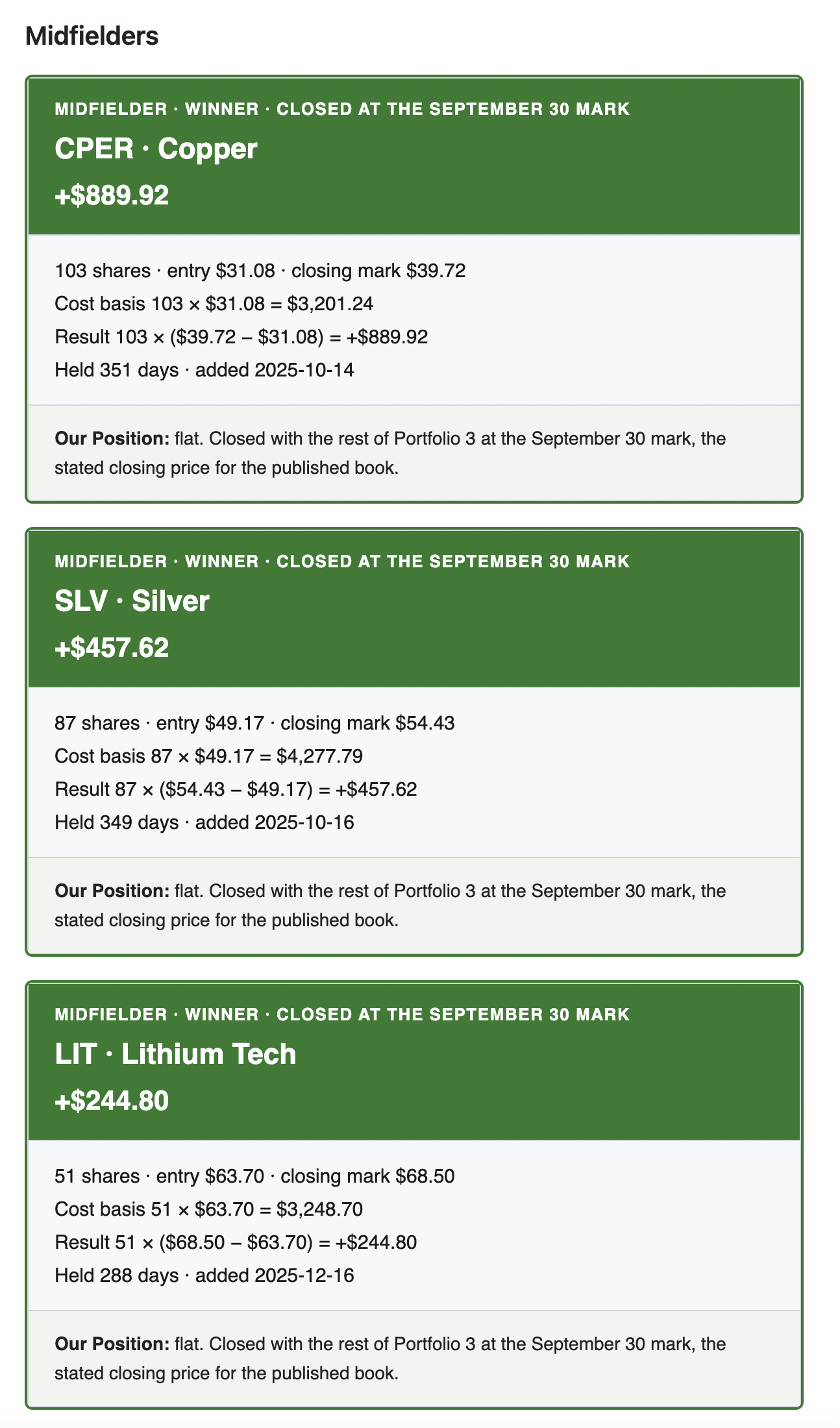
There’s a card below for every one of the eleven, grouped the way this book has always been grouped. One thing to be straight about before you read them. The book was closed at the September 30 marks. That is the stated closing price for the published portfolio, which is how a model book gets closed, and it’s the same pricing you’ve been reading on these lines all year. Every figure on every card is on that footing. Add the eleven together and you get the $6,054.41.
Why now
Because a lot of you are new, and you inherited a moving car.
If you joined recently, you opened the P3 tab and found a full book of positions you never saw us buy, at cost bases set months before you showed up, at prices you couldn’t get any more. You could read the whole thing and still not know why any of it was there. That’s a bad way to learn a portfolio and it’s a worse way to follow one, and there are a lot of you in exactly that spot now.
Starting from zero fixes it for everybody on the same morning. You’ll see the first position get opened. You’ll see the second one, and why it went on after the first. By the time the book is full you’ll have watched it fill, and that is a completely different thing from being handed it.
If you’ve been here since the start, I know what I’m asking. You’re giving up a book you already understand so that the people who arrived recently can learn it properly. I think that’s a fair trade and I’d make it again. You also get the version of this portfolio I’d build today rather than the version that accumulated.
What tomorrow actually is
Let me be straight about this, because I don’t want anyone expecting a new product.
It’s the same portfolio. Long positions, mainly ETFs, held outright rather than through options. Weighted by percentage allocation, the way it already is. Organized around the same four jobs it’s been organized around all year: goalie, defenders, midfielders, attackers. If you’ve been reading the P3 rows on the dashboard you’ve been looking at those labels on every line for months. They’re not new and I’m not pretending they are.
What’s new is that it’s clean, and that the weights get set deliberately on day one instead of being whatever all that adding and trimming left behind.
The goalie is the short-duration cash and cash-equivalent line. It doesn’t score. It stops the bleeding when everything else is having a bad month, and it’s the thing that lets me buy something when it’s cheap instead of wishing I could.
The defenders are the positions that are supposed to work when equities don’t. In a good year they cost you something. That’s the premium, and it’s the reason they’re in there.
Midfielders are the ones that can go either way depending on the regime. Metals, commodities, themes. They’re the most interesting part of the book and the most argued-about, and in a year where the macro call is genuinely uncertain they tend to be where the portfolio actually gets made.
Attackers score. Broad equity and growth, the part that carries the book forward when the tape is going up. Nobody has to explain why you want those. The argument is always about how many.
We launch tomorrow, from scratch. The allocation comes tomorrow with it. The specific names and the specific weights aren’t in this letter because they aren’t set yet, and I’d rather tell you nothing today than tell you something I’m going to change by the open.
And this next part matters more than the rest of it
The published Portfolio 3 has always run on a hundred-thousand-dollar stake. That was the model’s stated starting capital and never a claim about anybody’s actual account, but it had a consequence I didn’t like. Following it line for line took more money than most of the people reading it were working with. You could learn from it. You couldn’t really do it.
The new one carries no dollar values at all. Just percentages and entry prices. That’s the mechanism and it’s worth a second of your time, because it’s the whole reason the size problem goes away. A weight doesn’t belong to an account size. You’ll see what share of the book a position is and what we paid for it, you apply that percentage to whatever you’re working with, and you know what you paid against what we paid. Five thousand dollars follows that as cleanly as six figures does.
Different, not better. The old book was a model portfolio with a stated starting capital and it did its job for a year. This one is built so that more of you can actually run it, and that is the other half of why I’m doing this now. A book most people can’t run is a newsletter. I’d rather publish one you can use.
One limit worth naming while I’m here: a book published as weights and entry prices shows price movement, so dividends and interest sit outside it, the same way they sat outside the position table this year.
What doesn’t change
Every trade published, win or lose. The dashboard stays where it is. P3 is still where the macro commentary lives, because it’s the book where the macro view has to show up as an actual position rather than an opinion.
And the standard applies to the new book from its first entry: if a position is underwater you’ll read about it here, not find it yourself.
Bottom line
Twelve months of publishing Portfolio 3, and I’d rather run it from an empty account than keep explaining a cost basis nobody following along today could have gotten. The book is cash now.
Tomorrow we start from scratch. Nothing inherited, nothing already running, every position going on where you can watch it.
Disclaimer
This is not investment advice. Nothing in this letter is a recommendation to buy or sell any security. Grow Your Pile and Squared T Capital publish what we do in our own accounts for education. Options involve substantial risk and are not suitable for every investor. A short put can require you to buy stock at the strike price and can lose more than the premium collected. Past results do not predict future results. Do your own work and consider speaking with a licensed advisor about your circumstances.
Past performance is not indicative of future results, and results shown are those of our own accounts and are not representative of any subscriber’s results. Read the Characteristics and Risks of Standardized Options before trading.
Tony Rihan and Tony Battista Grow Your Pile
Every options trade in all three portfolios is published, win or lose, with entry, exit and running P&L at growyourpile.com.