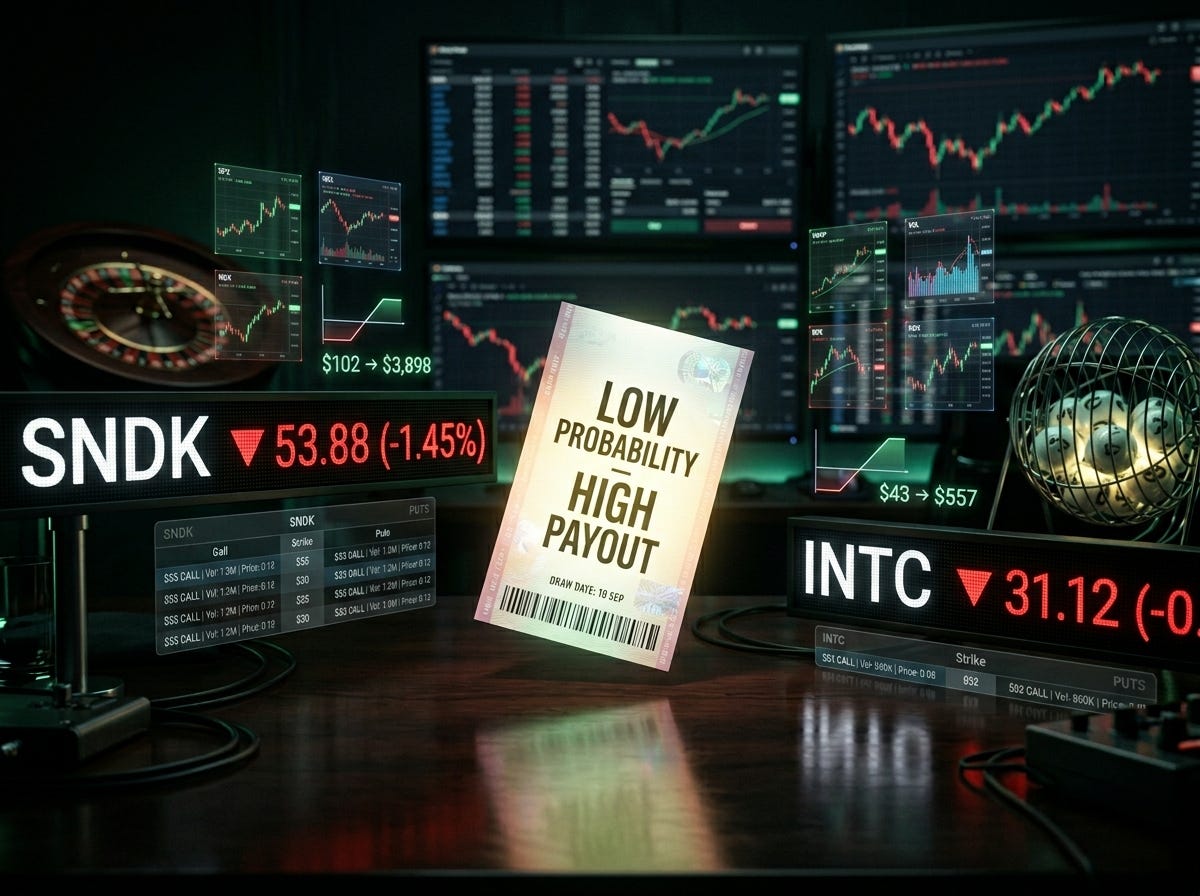
Taking a Shot: When We Step Outside Our Playbook - SNDK & INTC
They are not high-probability income trades. Just a Lottery Ticket!
This is not what we usually do.
And that’s exactly why it’s worth talking about.
At Grow Your Pile, our foundation is built on:
High-probability premium selling
Portfolio-level risk management
Letting time decay work in our favor
But every once in a while…
The market shifts.
And when it does — especially when we start seeing outsized, directional moves — we look for ways to add something we normally don’t prioritize:
Convexity.
These two trades are exactly that.
The Setup: Two Trades, Same Idea — Different Personalities
We’re looking at two defined-risk debit put spreads:
Trade #1 — High Convexity Shot (SNDK)
Structure: 1085 / 1045 Put Spread
Debit: ~1.02
Max Profit: ~$3,898
Max Loss: ~$102
Probability of Profit: ~3%
Delta: -1.23
👉 This is a true lottery-style convex trade
Trade #2 — More Realistic Shot (INTC)
Structure: 96 / 90 Put Spread
Debit: ~0.43
Max Profit: ~$557
Max Loss: ~$43
Probability of Profit: ~14%
Delta: -6.95
👉 This is still aggressive — but far more achievable
What These Trades Actually Are
Let’s simplify it:
These are not income trades.
They are:
Directional bets (to the downside)
Defined-risk
Low probability
High payout relative to cost
You are paying a small amount upfront…
For the chance that:
Price makes a fast, outsized move in your direction
The Key Difference Between the Two
This is where it gets interesting.
Trade #1 (SNDK) — Extreme Convexity
Very far out-of-the-money
Extremely low probability (3%)
Massive payout (~38x return)
This trade only works if:
The stock makes a violent move — quickly
There is no room for:
Slow drift
Chop
“Kind of right”
You either hit…
or you lose the entire debit.
Trade #2 (INTC) — Controlled Convexity
Closer to the money
Higher probability (14%)
Lower payout (~13x return)
This trade can work with:
A moderate move
Continued weakness
Even a slightly slower move
It’s still aggressive — but:
It lives in the realm of possibility
Why Put These Trades On?
Because markets right now are doing something important:
They are moving more than expected.
When that happens:
Premium selling becomes harder to manage
Expected move gets exceeded
Direction starts to matter more
So instead of fighting that…
We allocate a small amount of capital to:
Benefit from the move instead of just defending it
Portfolio Context (This Is Everything)
Let me be very clear:
These trades are NOT replacements for our strategy.
They are:
Add-ons
Small allocations
Opportunistic plays
Proper sizing:
1–2% of portfolio per trade
Treated as a defined loss upfront
If you’re wrong:
→ You lose the debit
If you’re right:
→ It can meaningfully impact returns
The Hidden Benefit: Psychological Edge
This is something most traders overlook.
When you are primarily short premium:
Big moves hurt
Positions get tested
You feel behind
Having trades like these:
Gives you positive convex exposure
Lets you participate in downside
Reduces the urge to over-adjust your core book
It’s not just about money.
It’s about:
Staying balanced as a trader
The Reality Check
Most of these trades will lose.
That’s not a bug — it’s the design.
You are paying for:
Asymmetry
Convexity
Opportunity
If you can’t accept losing 100% of the debit:
→ These trades are not for you
How We Think About It
We’re not trying to predict markets.
We’re trying to:
Stay consistent with our core strategy
Add tools when conditions change
Take calculated shots when pricing allows
So when we see:
Big moves
Momentum
Mispriced tails
We’re willing to step slightly outside the playbook…
But always with defined risk and small size.
Final Thought
You don’t build your portfolio on trades like this.
But every once in a while…
One of these hits — and it changes your month.
The key is not to gamble.
The key is:
To allow for outsized outcomes without putting your portfolio at risk
That’s the difference between:
Chasing moves
andBeing positioned for them
Disclaimer
This content is for educational purposes only and should not be considered investment advice. Options involve risk and are not suitable for all investors. The trades shown are examples based on specific market conditions and may not be appropriate for every portfolio. Always assess your own financial situation and risk tolerance before trading.


