


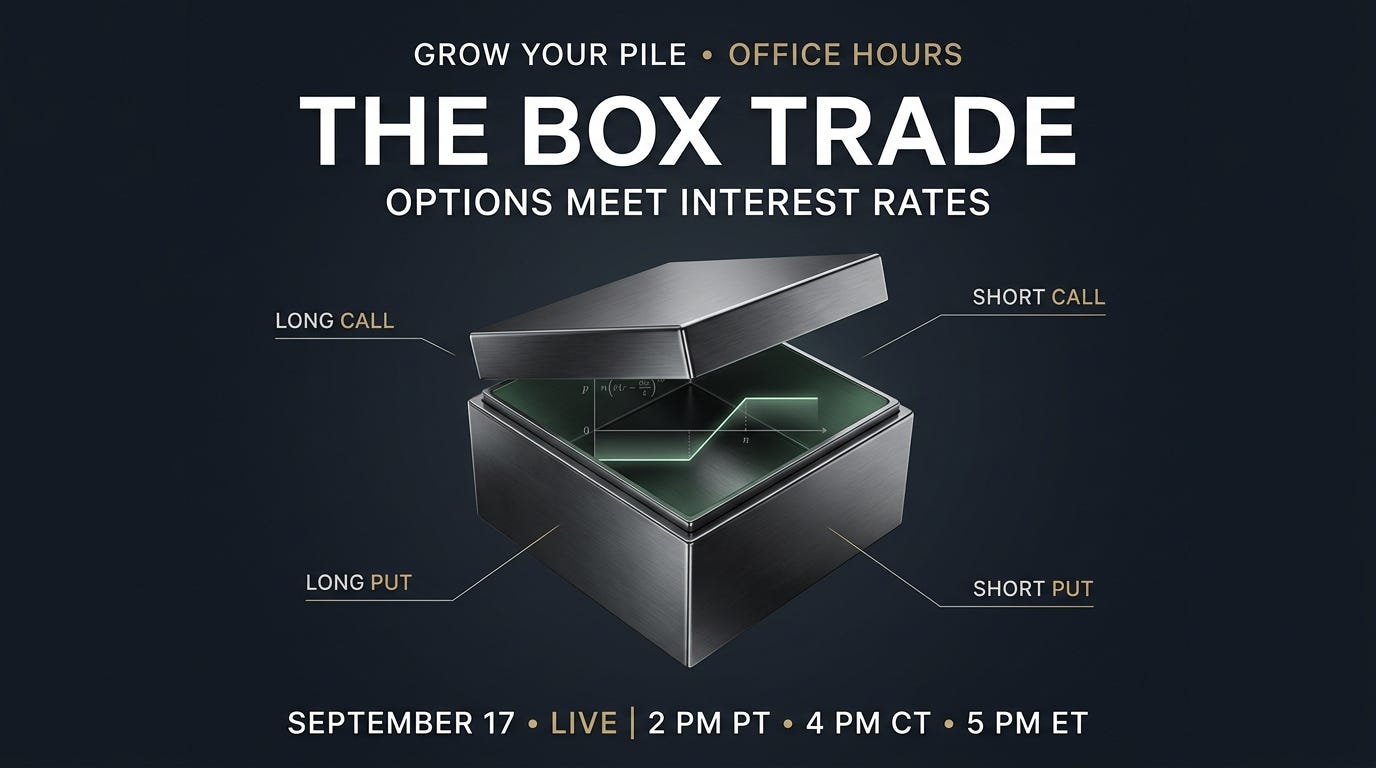
📅 Thursday, September 17, 2026 · 5:00 PM ET
Rihan doesn’t want to put money to work right now. He said it about four minutes in, before either of them had drawn a single option on a screen, and everything else in the hour followed from it. He thinks the tape is fragile. He’d rather have his cash somewhere sensible than have it in a hurry.
So he asked the room a question instead of answering one.
Suppose oil was over a hundred dollars a barrel and the ten-year was above five percent. What would you say the stock market was doing? Crashing, obviously. Somebody typed into the chat that it should be tanking.
It isn’t tanking. The S&P closed up 1.1% on Thursday at 7,636.21. What should happen doesn’t, and what shouldn’t happen does, and in a market like that the question of where your idle cash sits stops being boring and starts being the whole game.
Everybody has cash doing nothing. The usual answers are a Treasury bill, or one of the short-duration bond funds people park in so they don’t have to think about it. Thursday’s session was about a fourth answer that lives inside the options chain.
The curve he put on screen
He told everyone to screenshot it, because he doesn’t think these rates stay here.
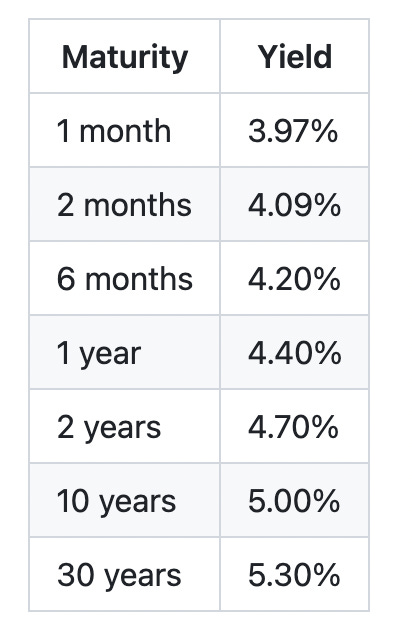
That is the Treasury curve as it stood on Thursday, September 17. Two-month paper at 4.09% he called unbelievable. Ten-year money at five percent is where he said it starts to get scary. He has a view about why we’re here, and it involves a government that wants to cut taxes, keep spending and cut nothing, but the view isn’t the point. The levels are the point, because the levels are what the box has to beat.
A reminder of what the thing actually is
We published the mechanics on Wednesday, so the short version.
A box is a bull call spread and a bear put spread on the same two strikes and the same expiration. Four legs. Buy the lower call, sell the higher call, sell the lower put, buy the higher put. Wherever the index finishes, the two spreads add up to the distance between the strikes, every single time. A thousand-point box is worth a thousand points at expiration whether the market rips, tanks or sits there.
Which means it isn’t a market trade at all. It’s a promise to pay you a fixed amount on a fixed date, and nobody pays face value today for money they get later. The gap between what you pay and what it settles for is interest, and that’s the entire trade. Buy the box and you’ve lent money. Sell it and you’ve borrowed.
The reason it works in SPX and not on your favourite ETF is that SPX options are European-style and cash-settled. No early exercise to blow up the financing math, and because it settles in cash, nothing turns up in your account overnight except money. It’s a zero-delta trade. Any delta it shows you is a rounding error.
There’s a version of this on the other side of the trade, and it has nothing to do with lending. More on that below, along with the part Rihan found by accident.
Paid subscribers: the yields they priced live, the trick that turns a box into a hedge, and the replay.
The box he’s been sitting in since January
He owns one right now. Six hundred points wide, bought back in January, expiring in January 2027, centered at the money when he put it on because that’s how he likes to do them. He chose a January expiration on purpose, so the gain would land in the following tax year. Whether that actually works is a question the room raised on the spot, and we come back to it below.
He paid 577.90 for it. It settles at 600.
600 minus 577.90 is 22.10. At SPX’s $100 multiplier that’s $2,210 of profit per box, locked in the day he bought it, and 22.10 divided by 577.90 is 3.8% for the year.
He was happy with 3.8% in January. He is not happy with it now, and he said so without being asked. Rates moved after he was already in, and there is nothing to be done about it. That, he said, is the reason he now has to hold it.
He can’t sell it, because selling it now means eating the mark. He’s locked in at 3.8% while the same structure on Thursday paid close to five. That is not a box problem. That is the oldest problem in fixed income, and it’s the reason the rest of the session kept coming back to duration.
The box is marked at about 590 now with four months to go, and it will crawl to 600 by expiration whatever the market does in between. Battista, watching the individual legs swing around: the position is defined, and it is still remarkable how far the pieces travel to get nowhere.
Two boxes, priced live
They built a six-month box on the platform. SPX was at 7,636 on the close, and they used a 600-point structure around it, 182 days out to the March expiration.
Assume a fill at 585.65. That’s $58,565 of cash out the door today for a box that settles at $60,000, so $1,435 of profit per contract. Annualise 14.35 points over 182 days against a 585.65 debit and you get 4.91%.
Then the one-year, September 2027, 364 days out. Filled on paper at 570.95. That’s 29.05 points, $2,905 per contract, and a shade over five percent. The platform’s own math put it at 5.08%.
Now hold those against the curve at the top of this email. The six-month bill was 4.20%. The one-year bill was 4.40%.
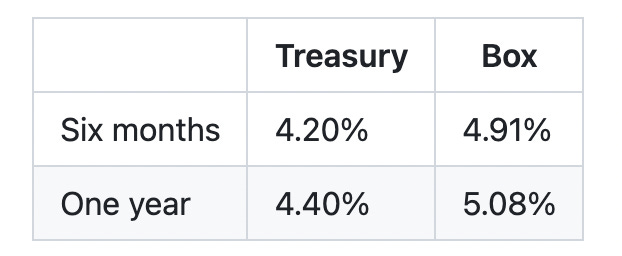
About seventy basis points at both tenors, for doing a little arithmetic and clicking four legs instead of one. And notice the shape holds: the two boxes are about seventeen basis points apart, which is near enough the twenty that separates the two bills. The box curve goes up and to the right the same way the Treasury curve does, because it’s pricing the same thing.
Why is there a gap at all? Because a market maker funds himself far more cheaply than you do, and he’s willing to pass some of that on to take the other side. Nobody trading from a retail screen could make that market as tight as SPX already makes it, and that was said out loud on the call. It isn’t a complaint. It’s the reason the trade exists.
A question came in about whether this replaces the T-bill funds entirely. The answer was split, and it’s the right answer. For money that has to sit still for six months or a year, yes, all of it. For the money you need moving in and out to trade with, no. Those funds pay a little less than owning the bill yourself, and that gap is the sponsor’s fee. Rihan has a theory about whose Connecticut property taxes it pays.
Getting filled without giving it all back
This is where a box goes wrong, and it’s the same warning that was in Wednesday’s note, except now there’s a method attached.
Don’t trade the displayed mid. Start aggressive, then work up in quarter and half-dollar steps until something gives. And if you want ten of them, fill one first and find out where the real price is before you show the market that you want nine more.
They also looked at the volume on the individual strikes and decided the month they’d picked wasn’t the most liquid, so they moved to a strike with more business going through. The structure doesn’t care. A box is a box whether it’s fifty points wide, six hundred, or a thousand. The width just decides how much money you’re lending.
Cash and buying power are not the same thing
The best question of the hour, and the one most likely to surprise somebody who tries this.
Buying a box eats cash, in full. One 600-point box at 585.65 takes $58,565 out of your cash balance. Under portfolio margin the buying-power hit is a small fraction of that, because the position is defined and the broker knows it. Rihan’s rough number was about ninety percent relief.
So your buying power barely notices and your cash balance takes the whole thing. If you’ve been thinking of those two as the same number, this is the trade that teaches you otherwise.
The risk nobody names, because it doesn’t feel like risk
Hold it to expiration and you get your money. That part really is fixed.
The risk is everything before expiration. If rates rise after you’re in, your box marks down, exactly the way a bond does. Rihan told the story against himself: he bought ten-year Treasuries at the start of the year at a bit over four percent, paid par for them, and they’re marked below par now. He earned the coupon and lost it back on the principal. On that slice of his money he’s made nothing.
“If you are going to need the money to do the box, then you should not do the box.”
Which is why he keeps these short. Six months, a year, eighteen months. Go long enough and you’ve built yourself a duration problem with a guaranteed payoff attached, and the guarantee doesn’t help you on the day you need the cash.
There’s a good version of this too. If rates fall while you’re holding, your box marks up and you can take the money early.
The thing he found by accident
He was dragging strikes around on the analyze tab one day, setting up a box, and the risk graph changed in a way it had no business changing. So he did the math and worked out what he’d done.
Start with the one-year box, 7325 and 7925, guaranteed $2,905. All green on the graph.
“It looks like you can’t lose.”
Now take the short put and walk it down. At 7275 the upside profit shrinks. Keep going to 7200, a hundred and twenty-five points below where it started, and the graph turns into something else entirely: about $135 to the upside, and roughly $12,000 to the downside if the index finishes below the lower strike.
You haven’t bought a hedge. You’ve spent the guaranteed profit on one. What’s left inside the position is a long put vertical, paid for with money you’d otherwise have collected for certain.
Battista recognised the shape straight away. It’s a broken-wing butterfly turned inside out: you’re synthetically short an embedded spread, you buy it back, and now you have a free shot at a move you weren’t positioned for. The difference is that here you’re doing it deliberately, and paying for it with a profit you could have simply kept.
The same trick works to the upside. Walk the short call up instead, from 7925 to 7975, as far as you can go before red appears on the graph, and you’re looking at about $5,000 if the market runs.
Five thousand to the upside, twelve thousand to the downside, same amount given up. That asymmetry is put skew, and it’s not a quirk, it’s the market charging more for downside protection than for upside participation, which it does approximately always.
Rihan’s own verdict on the upside version was honest and slightly grumpy: he’d rather keep the $2,905 than give it up for a shot at $5,000. The downside version interests him more, and he’d manage it rather than just hold it, because a down move gives you a chance to take part of that put spread off long before expiration.
He also warned the room, correctly, that once you start moving strikes you are no longer running a box. You’re running a directional trade wearing a box costume, and you should know which one you own.
Selling the box: borrowing through your trading account
The last fifteen minutes went somewhere most options education never goes.
Reverse all four legs and everything flips. You are not guaranteed a profit, you are guaranteed a loss, and the cash lands in your account today. Sell that same one-year box and roughly $57,000 shows up, against a guaranteed $2,905 cost at expiration. That’s the interest.
And you can withdraw the money.
They worked the example with a piece of property. Pay $57,000 cash for it and you own it free and clear. Or sell the box, pull the $57,000 out, buy the same property, and you still own it free and clear, except you’re holding it with money that isn’t yours. There are a lot of videos going around about exactly this.
Both of them put the caveats on the table, hard, and they belong in this email as much as the idea does.
The loan has an expiration date. That money has to go back. You can roll it, but rolling needs capital, and if you haven’t got it the margin desk makes the decision for you. Someone asked what a safe amount to borrow against a hundred-thousand-dollar account looks like, and the answer was that the box doesn’t change anything about that: it’s whatever you could safely withdraw without the box.
And the version of this where you get something for nothing got shut down on air. If you already have the cash for the property, borrowing through a box and then buying the property with the cash you were always going to spend is not a second source of money.
“It’s all one nest egg.”
Nobody on the call was recommending it. It was put out there because it’s a thing people are doing, and because it’s legal. What it does is swap an interest expense for a capital loss. That’s the whole difference, and whether that trade is worth making is a conversation with your accountant, not with us.
The tax question, left open on purpose
He picked a January expiration on his own box to move the gain into the next tax year. Somebody in the chat immediately pushed back: these get marked to market at year end anyway.
Rihan’s answer was that he believed that applied to people filing with trader status, and he doesn’t have it. The other half of it came up on the call: SPX options get 60/40 treatment, so even under a year-end mark a big chunk of the profit is treated as long-term.
Neither of them is a tax advisor and both said so. Rihan said he’d go look into it properly. We’re publishing the question rather than the answer, because we don’t have the answer and you should ask somebody who does before you build an expiration schedule around it.
What we’d actually take away
Idle cash should be earning something. If you have enough of it, buy the bill. If you need it liquid, the T-bill funds are fine and they cost you a little. If you have a trading account and you’re willing to do the arithmetic, the box paid about seventy basis points more than the bill on Thursday afternoon, in the same dollars, over the same window.
The word “guaranteed” got used a lot on the call, including by Rihan, who wrote in his own notes beforehand that the word needs using carefully. Both things are true. The payoff is fixed at expiration. The path is not, the fills are not, and the cash it consumes is very real.
